
By Carmen Delgado, Art Editor
For centuries, the name on the work was the person who directed it, not necessarily the person who made it. AI didn’t invent that arrangement. It inherited it — and then broke some of its rules.
Every argument about AI and creativity eventually lands on the same accusation: you didn’t make that. You just told a machine what to make.
It is meant to end the conversation. Historically, it starts one — because “just telling someone what to make” describes a large, expensive, and entirely respectable share of the art in our museums.
The price was in the hand — literally
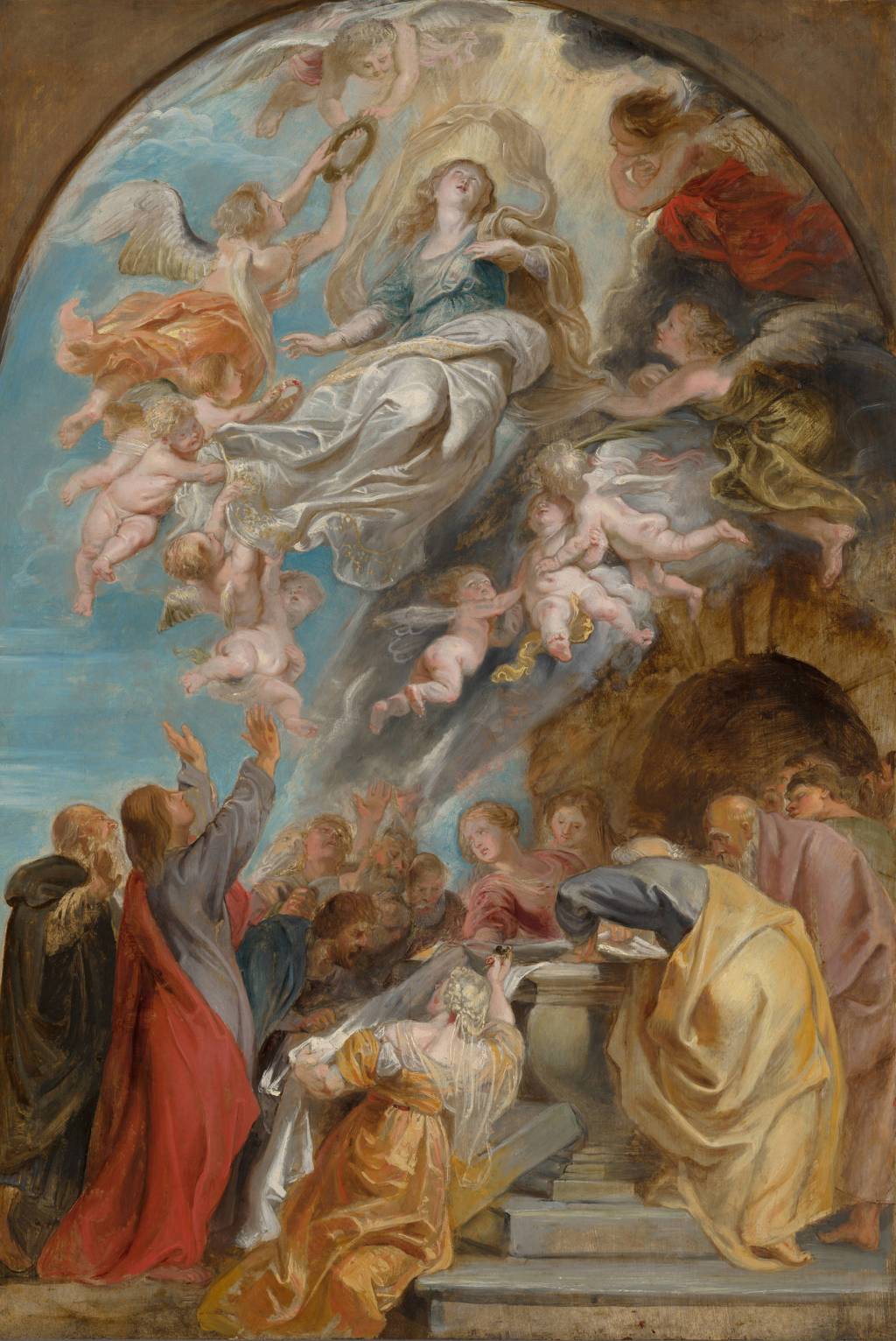
Peter Paul Rubens ran one of the most productive studios in 17th-century Antwerp, with dozens of assistants and pupils working under him. His practice was transparent and commercial: he made the small oil sketch — the modello, the idea — and assistants scaled it up, blocked it in, and specialized. Frans Snyders painted the animals. Jacob Jordaens helped. The young Anthony van Dyck passed through.
And the amount of Rubens himself in the finished canvas was, as his letters show, a question of price. A client could pay for a work painted entirely by the master, pay less for one he painted in part — a face, a pair of hands — or pay less still for one he only supervised from his drawings. Three tiers. All sold as Rubens.
Rembrandt’s Amsterdam workshop worked the same way, and left scholars a mess we still haven’t cleaned up. Pupils copied his paintings, he sometimes finished or retouched them to be sold as originals, and a signature from the master could go on a student’s work because, as the Mauritshuis puts it, if it was painted in Rembrandt’s studio, it was his “product.” Four centuries later, an entire research project has spent decades trying to un-sort which “Rembrandts” his own hand actually touched.
Nobody calls Rubens a fraud for this. We call it a workshop.
The Factory, the spots, and the balloon dog
Andy Warhol didn’t bother with euphemisms. He called his studio the Factory, and in 1964 told a journalist, “I’m becoming a factory.” His assistant Gerard Malanga — hired in 1963 at $1.25 an hour because he knew silkscreening — put out the Elizabeth Taylor portraits, Ethel Scull 36 Times, the Elvises and the Death and Disasters alongside him, and by some accounts painted several canvases entirely by himself. By the 1970s, Warhol’s production was running by telephone.
Damien Hirst painted five of his spot paintings himself, by his own count, and stopped because, in his words, he couldn’t be bothered. “The best person who ever painted spots for me was Rachel,” he has said of his assistant Rachel Howard. “The best spot painting you can have by me is one painted by Rachel.” By 1999, two assistants had painted 300 of them. Hirst’s defense is blunt: the creative act is the conception, not the execution.
Jeff Koons employs fabricators, painters, and technicians — at its peak, a Chelsea studio of 90 to 120 people — to build and polish work he designs on a computer, using a color-by-numbers system so assistants can execute a canvas “as if it had been done by a single hand.” “I’m the idea person,” he says. “I’m not physically involved in the production.”
Takashi Murakami’s Kaikai Kiki studio does the same at industrial scale, sometimes putting the names of everyone who made a canvas on its back — like film credits. For his 100-meter 500 Arhats, more than 200 staff worked in shifts, around the clock.
LeWitt wrote prompts
The closest anyone came to AI before AI was Sol LeWitt.
From 1968, LeWitt made more than 1,200 wall drawings that exist not as objects but as instructions — a set of written directions that trained assistants, artists, or novice volunteers execute on a wall, often without him present. The work can be painted over and re-made elsewhere from the same certificate. The drawing varies slightly every time, because different hands, walls, and judgments interpret the instructions differently.
LeWitt compared himself to a composer whose score is played by musicians for generations. His sentence for it, from 1967, is the one AI-era artists should have somewhere permanent: “The idea becomes a machine that makes the art.”
Replace “instructions executed by others” with “a prompt executed by a model,” and the formal structure is nearly identical: conception here, execution there, variation in between, authorship claimed by the person who wrote the directions.
Painting is the outlier, not the rule
Part of why this feels scandalous in painting is that painting is where we invented the myth of the lone genius — a Romantic-era story that the solitary hand equals sincerity.
Almost no other creative field believes it.
No one asks whether an architect laid the bricks. A film director is the author of a film they did not act in, light, or operate the camera for. An executive chef creates a dish a line cook plates four hundred times a night. A fashion house, a recording studio, an architecture firm, an orchestra — all of them separate the person who decides from the people who do, and credit flows to the decider.
The AI-using creative is not proposing a new definition of authorship. They are importing the normal one from film, music production, and design into fields that held out longer.
Where the comparison breaks
That is the honest half of the argument. Here is the other half, because the comparison is not perfect, and pretending otherwise weakens it.
1. An assistant can push back. A model cannot — not really. Van Dyck learned in Rubens’s studio and became Van Dyck. Rachel Howard became a significant painter in her own right. Assistants interpret, resist, improve, misread productively, and carry a tradition forward in their own names. An AI system does none of that. It has no judgment forming underneath yours, no apprenticeship, no career being built inside your process. The workshop was a school. The model is not being educated by your prompt.
2. The training question is genuinely new. Rubens’s assistants consented to be there, were paid or were paying for training, and learned a style from a living master who taught them directly. AI models are trained on the work of millions of people, most of whom were never asked, are not credited, and are not paid when their influence surfaces in an output. You can defend the workshop precedent for execution all day. It does not settle the training data question. That one has no 17th-century answer.
3. Prompting alone is thinner than directing. The U.S. Copyright Office reached a version of this distinction in its January 2025 report on AI and copyrightability: merely entering a prompt does not, by itself, provide enough control over the expressive elements to make the prompter the author of the output. What can count as human authorship is the work around it — original material fed in, creative selection and arrangement of what comes out, substantial modification and editing.
That is a useful line, and it maps surprisingly well onto the workshop. Rubens did not just say “paint me a crucifixion.” He made the modello. He sketched, corrected, retouched, rejected, and finished. The directing that earned authorship was specific, skilled, and sustained. A one-line prompt and a screenshot is not that. A hundred iterations, a trained eye rejecting ninety-nine of them, compositing, repainting, sequencing, scoring, and signing your name to the final decision — that starts to look much more like it.
4. Scale changes the ethics. A workshop was limited by bodies, wages, and daylight. Its output was expensive because its labor was. AI removes that friction, which is why the same defense that covers one directed work feels different when it covers ten thousand works generated in a weekend. Scarcity was never the source of art’s value, but abundance is a new condition, and it puts pressure on the one thing the workshop system did guarantee: that directing was itself hard work.
A better test
So the old question — did you make that with your own hands? — is the wrong one. It would fail Rubens on a mid-tier commission, fail LeWitt by design, fail Warhol, Hirst, Koons, and Murakami, and fail every film director and architect working today.
The better test is the one the workshop actually used:
Did you conceive it specifically, not vaguely?
Did you direct it through real choices — selecting, rejecting, correcting, finishing?
Can you explain why this version, and not the ninety-nine you threw away?
And will you put your name on it and answer for it?
If yes, you are standing in a very old line, and the tool in your hand — a pupil, a factory, a silkscreen, a model — matters less than the decisions you made with it.
If no — if the prompt was generic, the output untouched, the selection arbitrary — then the problem is not that you used AI. Rubens’s name on a canvas he never touched still meant something because everyone knew what his judgment was worth.
The problem is that there was no judgment to sign.
Filed under: Art · Artificial Intelligence · Art History · Authorship



Leave a Reply