
From 1789 to the pension freeze, the French state answers hunger with dessert — and the crowd keeps sending it back
By Margaux Delacroix, Editor-in-Chief
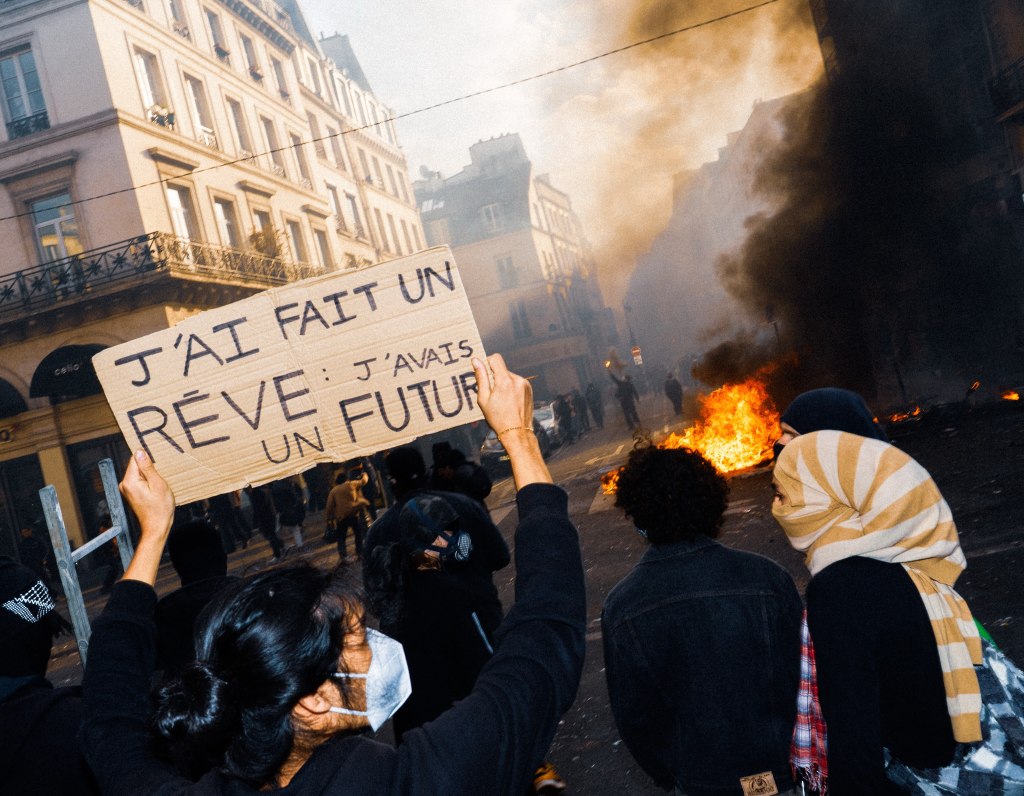
Begin with a correction, because the whole story is in it. Marie Antoinette never said “let them eat cake.” The line belongs to Jean-Jacques Rousseau, who in his Confessions — written in the late 1760s, published after his death — recalled the words of an unnamed “great princess” who, told that the peasants had no bread, replied: Qu’ils mangent de la brioche. Let them eat brioche. No name. No queen. When Rousseau wrote it, Marie Antoinette was a child in Vienna; she would not set foot in France until 1770. The sentence was pinned on her later, by a revolution that needed its villainess to have a voice, and it has stuck for two and a half centuries.
Sit with that for a moment. The most famous insult ever offered to a hungry crowd was never offered at all. Even the sneer was ghost-written — an elite fiction about what the elite think of the people, circulated, in the end, by the people themselves. France tells its politics in the language of food, and its founding culinary legend is a forgery. Worth remembering this week, because the modern French state has refined the arrangement: it no longer insults the crowd with cake. It serves the cake, and calls the serving a concession.
October, the first time
The original scene involved no cake whatsoever. On October 5, 1789, the women of the Paris markets — the fishwives and market traders who sold the city’s food and knew the price of a loaf the way a cashier knows the till — marched twelve miles in the rain to Versailles. Bread was scarce, bread was dear, and the court’s answer had been process: committees, inquiries, the slow cuisine of governance. The women declined to wait for it. They invaded the palace; the National Guard followed behind them; and the next day the royal family was brought back to Paris in a carriage at the centre of the crowd, who sang as they walked that they were bringing back the baker, the baker’s wife, and the little baker’s boy.
They did not eat cake in 1789. They went and fetched the baker. That is the fact the famous sentence exists to obscure: when the French crowd is hungry, its instinct is not to accept a substitute but to walk to the source and bring the source home.
Rhyme it against October 2026. This autumn’s movement began, again, with those who do the arithmetic of a life earliest: high-school students, blockading their own schools from mid-September, counting forward to a retirement age moved two years further away. The month is the same. The reflex is the same. Faced with a state that answers in procedures, the crowd — first the children, then everyone — goes in person to fetch an answer.
The modern menu
Consider what the state has actually served, course by course.
In 2023, President Macron raised the retirement age from 62 to 64 and, unable to carry his own parliament, forced the reform into law by constitutional decree — Article 49.3, March 16 — surviving the no-confidence vote that followed by nine votes. A meal imposed is not a meal shared; the country answered with the largest protest days of the modern era. The reform stood.
Then came the course that perfected the genre. In October 2025, Prime Minister Sébastien Lecornu suspended the reform: the legal retirement age is frozen at 62 years and nine months, the rise in contribution years paused — until January 2028, which is to say, until after the presidential election. A suspension is not a repeal. It is the reform, preserved intact, placed under a glass dome and wheeled past the table. The demand, from the first day in 2023 to last Saturday’s marches, has never been for a pause. It has been for the reform itself to go. The reform does not move.
After the weekend of fire, the service continued. On Sunday the interior minister, Laurent Nuñez, offered his resignation; on Monday morning the Élysée refused it — he must stay, the announcement explained, to ensure “continuous command of law enforcement.” The diner who sent back the dish was informed the chef would remain. The prime minister’s instruments were curfews, specified as “partial and localised,” as if a curfew, like a sauce, improved with portion control. For the looted shopkeepers, furlough support and a business fund: compensation — real, and also the smallest item on the bill anyone presented. For the movement, consultations, beginning this week. For its deepest demand — the reform itself — nothing beyond the dome.
France knows this kitchen can cook when it chooses. In 2018 the yellow vests rose over a fuel tax, and Macron scrapped the tax within three weeks — a concession with calories in it. The current house style is different: every answer arrives beautifully plated and nutritionally empty. Anger and shame, in the president’s Sunday words. Nothing justifies, nothing excuses. A diagnosis, a consultation, a fund, a freeze. Cake, in all its modern forms, to a crowd that presented a bill.
The bill
Because a bill is what it is, and bills are itemised. Over the weekend of October 17, some 2,400 people were arrested. Nine hundred ninety-seven police officers, gendarmes and firefighters were injured, seven of them seriously. Two people died: a protester, whose heart stopped in the Paris crowd, and a 22-year-old police officer in Nantes, struck and killed by a third-party vehicle. At least three thousand businesses were damaged or looted, by the commerce minister’s own count. And beneath the weekend, the month: since the movement began in September, 7,950 people have passed through police custody — 6,773 of them minors. Schoolchildren, in cells, by the thousand.
Set the menu beside the ledger and the insult of it clarifies. These are not people awaiting dessert. They are people who have already paid — in custody, in injuries, in a burned common house in Limoges — for a demand that has been consistent for three years and never once answered in kind. A state may refuse a demand; democracies do it constantly, and survive. What corrodes is the theatrical alternative: the refusal disguised as a serving. The crowd can read a menu. It knows the difference between the meal it ordered and the cake that keeps arriving in its place.
The man who brought no cake
Eleven days before the weekend, on a Paris street full of gas, the moment found the one public figure who understood the etiquette. Bally Bagayoko, the mayor of Saint-Denis, stepped between the riot police and the school students behind him, arms spread, shouting for the charge to stop — and was tear-gassed with the children, his eyes rinsed with saline on camera. The Grvy told his story at length in “The Mayor Stood in Front of the Children.” What matters here is the contrast. The mayor of France’s poorest big city offered the state no theory and the crowd no dessert. He offered his body, which is the opposite of cake: substance, uniced. That is why the New York Times calls him the face of France’s youth protests, and why the Élysée — serving the third year of the same menu — is not.
Still baking
The consultations open this week. The yellow-vest networks have called a second act for Saturday, October 24. Five unions have set a national strike day for November 5. None of these dates asks for anything new; the order has been on the kitchen’s board since 2023, and it is not complicated: take the reform off the table, not under a dome.
The state, one assumes, will keep baking. It will frost the freeze, slice the curfews thinner, sweeten the fund, and express, handsomely, its anger and its shame. And the crowd will do what it did in the October when this story started, the October of the women who walked to Versailles through the rain. It did not eat cake then. It went and fetched the baker. Why should it eat cake now?
Sources: Reuters, the Associated Press, AFP, Le Monde, Le Figaro, France 24, RFI, El País, BFM TV, franceinfo, Le Parisien, Le Nouvel Obs, CNN and the New York Times, October 6–19, 2026; Rousseau, Confessions, Book VI (written 1765–69). Figures are official counts as published on October 19, 2026, and remain subject to revision.




Leave a Reply