
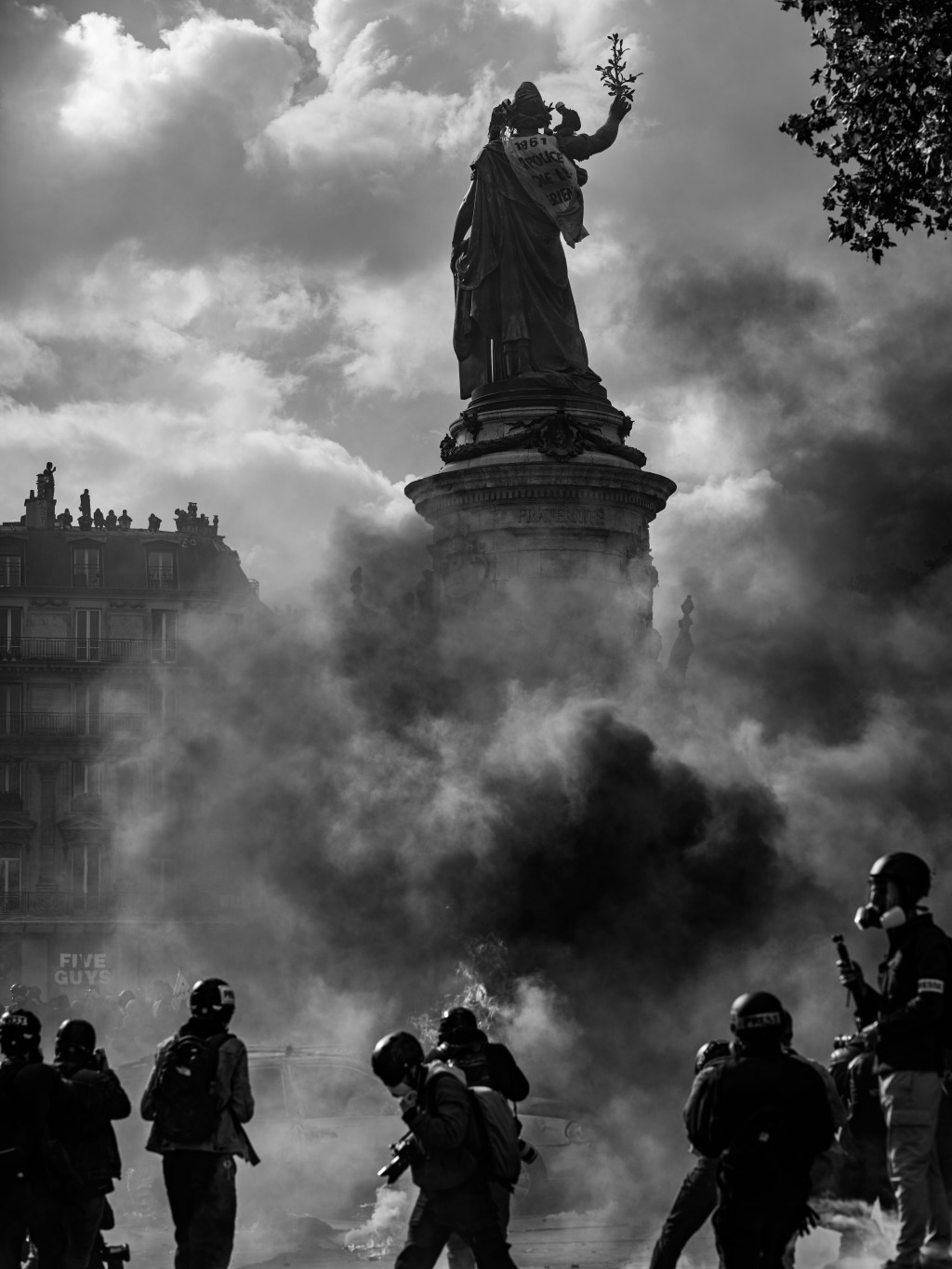
France’s weekend of fire began in its classrooms — and the state is still counting what it cost
By Margaux Delacroix, Editor-in-Chief
At 2:24 on Saturday afternoon in Aix-en-Provence, they were still a procession. Citizen cameras — and in France this autumn, the citizen cameras are the archive — show the march passing the bus station in good order, banners up. By 3:43 the crowd on the avenue de l’Europe was singing the Marseillaise, all of it, the way crowds sing an anthem when they intend to remind the state whose it is. By 4:42 they had walked out onto the A8 motorway at Pont de l’Arc and stopped the traffic of the republic with their bodies. Nothing about Aix was exceptional — that is the point. What happened there happened in more than a hundred French towns on October 17, and in a handful of cities, Paris above all, it kept happening until it was no longer a procession at all.
The day
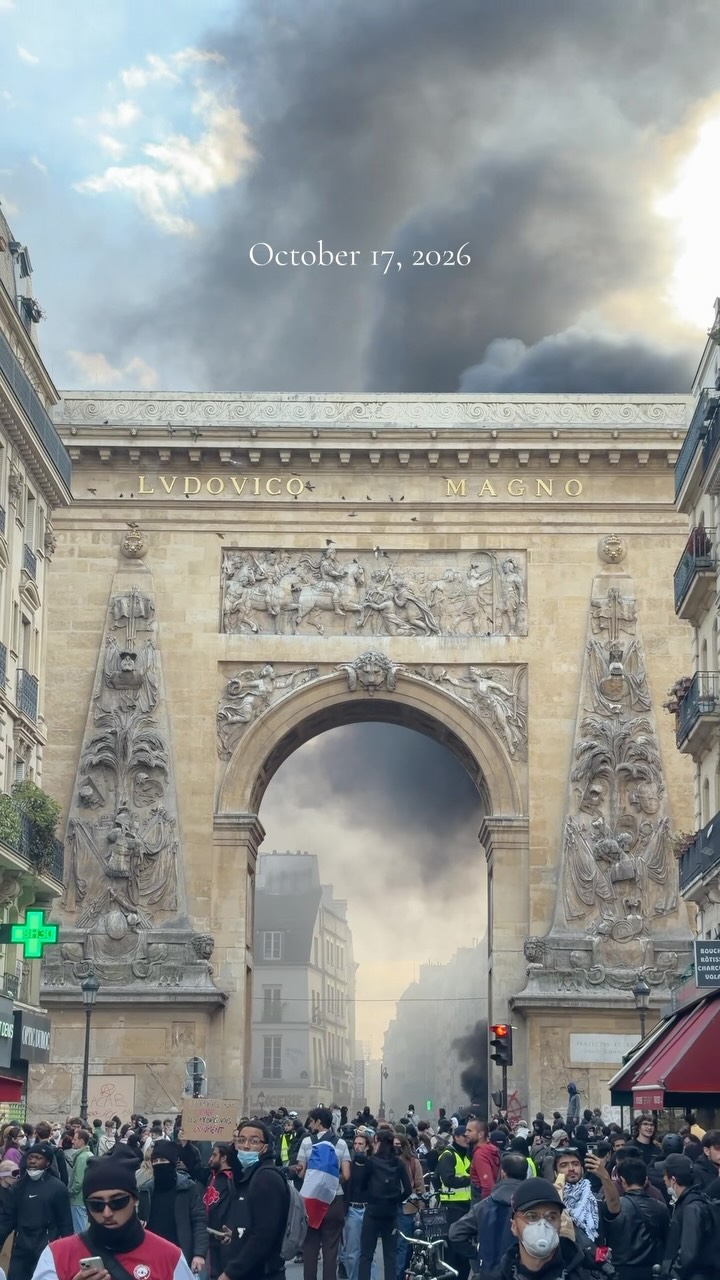
The Interior Ministry counted 550,000 people in the streets; the CGT counted 800,000. One hundred and ten marches. In Paris, 110,000. The coalition had no single name because it had no single wound: high-school students who had been blockading their own schools for a month, trade unionists carrying demands on wages and pensions, and the yellow-vest networks of 2018, returned like a tide the country had agreed to forget.
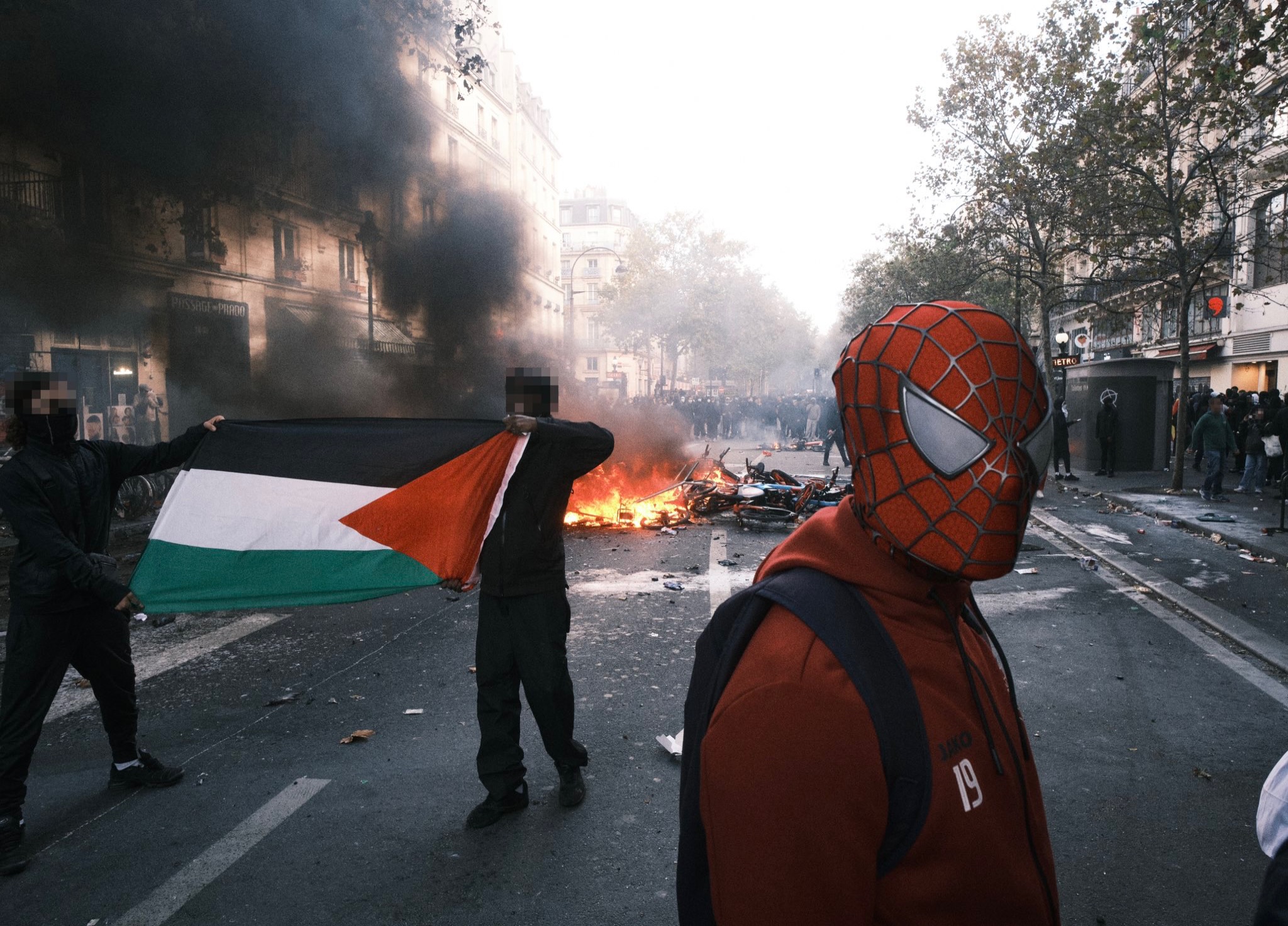
Most of them marched and went home. The distinction matters, and every official account of the weekend makes it. But by evening, in city after city, groups broke away and the day changed its nature. In Paris, around Place de la République, cobblestones were ripped up and a car burned; shops were looted in the tourist districts; at Place Vendôme, the door of Dior was smashed and the windows of Rolex, Louis Vuitton, Ralph Lauren and Gucci damaged. Some demonstrators tried to approach the presidential palace. In Lyon the tourist office on Place Bellecour was burned. In Bordeaux, intruders got inside the prefecture’s residence. In Marseille, protesters entered the city hall and a bust of Marianne — the republic’s own face — was toppled in its hall.
And in Limoges, they burned the town hall: the Hôtel de Ville of 1883, a listed monument, its roof and clock tower collapsing into the fire. Mayor Guillaume Guérin called it deliberate, premeditated. Of all the weekend’s images, this may be the one that endures, because of what a French town hall is. It is not an office. It is the maison commune, the common house — the room where the republic marries you, registers your children, buries your parents. To burn it is a message addressed to the idea of the state at the exact address where the state is most intimate. On Monday, mayors across France stood before their town halls at noon, defending the building as one defends a body.
The long fuse
France did not arrive at October 17 in a day, or a year. It arrived the way it always arrives: by sediment.
The topmost layer is a month old. In mid-September, teachers at the Lycée Antoine-de-Saint-Exupéry in Créteil, southeast of Paris, struck over unfilled posts and decaying buildings; within days their students were blockading the school themselves. The blockades spread the way things now spread — group chat to group chat, TikTok to TikTok — through the working-class suburbs of Seine-Saint-Denis and Val-de-Marne and then everywhere. The Armed Conflict Location & Event Data Project counted more than a thousand student-led demonstrations in five days at the end of September. The grievances were almost embarrassingly material: classrooms without teachers, toilets without doors, the Parcoursup machine sorting eighteen-year-olds into futures. The date of October 17 — a Saturday, the first day of the Toussaint holidays — was proposed in a TikTok video by a user known as V2, watched a million and a half times. He later withdrew; the date did not. The movement accumulated some 132 million views, and every other grievance in the country attached itself to it: fuel prices that had already forced the release of ten million barrels of diesel from strategic stocks; inflation at 3.1 percent, energy up more than a fifth in a year; a draft 2027 budget demanding a €54 billion adjustment from a country that did not feel it had €54 billion of slack.
And beneath all of it, the old sediment: pensions. In 2023, Emmanuel Macron raised the retirement age from 62 to 64 and, unable to carry parliament, forced the reform through by constitutional decree — Article 49.3 — surviving the ensuing no-confidence vote by nine votes. The country answered with the largest protest days of the modern era: the ministry’s own count touched 1.28 million on a single March day; the unions claimed three and a half million. The reform stood. Then, last year, it quietly bent: Prime Minister Sébastien Lecornu, buying his government’s survival, suspended it; the legal retirement age is frozen at 62 years and nine months until January 2028 — which is to say, until after the presidential election. The pension question, on which French people measure whether the republic keeps its promises, has been left officially unanswered and placed in the custody of the next election. The unions marched on Saturday demanding pensions rise. A promise postponed is a promise in escrow, and the crowd had come, in part, to check on the deposit.
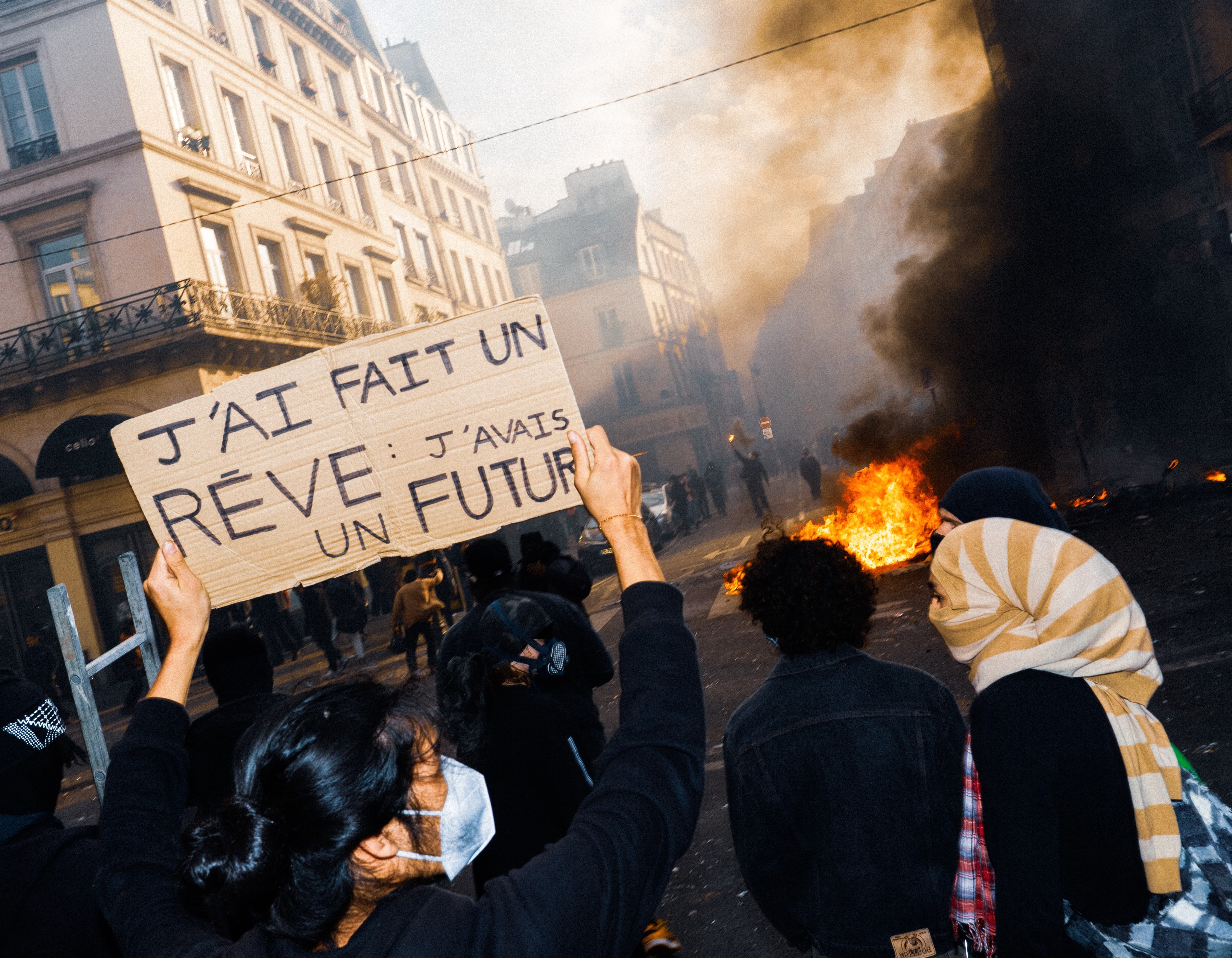
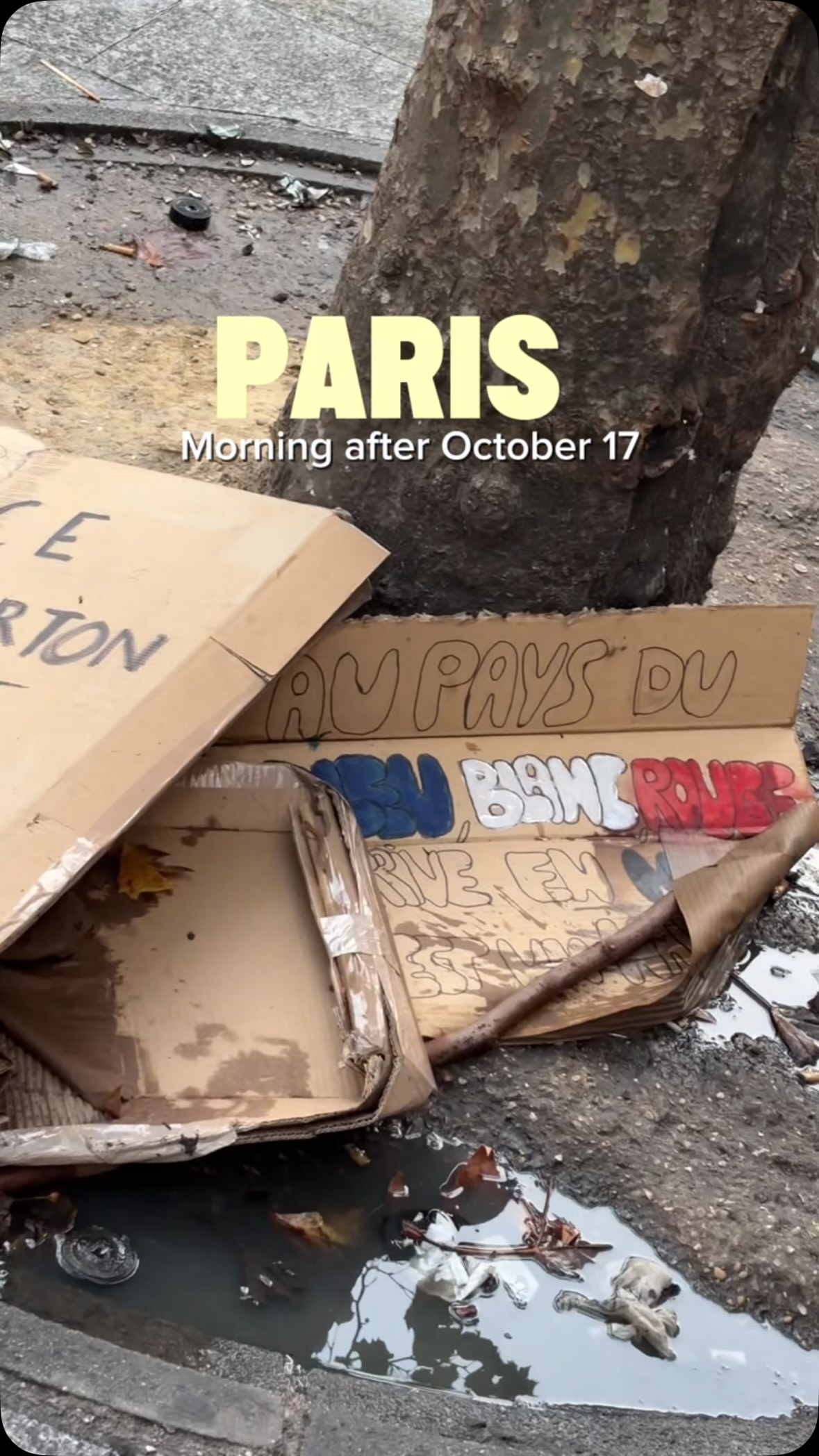
There is a photograph from Paris that explains the month better than the ministry’s figures. A young protester, masked, holds a handmade sign; the photographer who posted it transcribed the placards around it, and one read: « J’ai fait un rêve : j’avais un futur. » I dreamed I had a future. The French protest tradition is usually described as a reflex, a national sport, a theatre. In front of that sign it looks more like an accounting exercise conducted by other means: a generation presenting the state with an itemised bill for the future it was issued and cannot find.
The mayor
Every French crisis mints an image, and this one’s was minted eleven days before the weekend, on Tuesday, October 6, in a Paris street full of smoke.
Bally Bagayoko is 53, the son of a Malian auto worker, raised in Saint-Denis, the poorest big town in France — poverty there runs at more than double the national rate — a former RATP manager who sat on the council for nineteen years and coached basketball. In March he won the mayor’s office in the first round with just over half the vote, defeating the Socialist incumbent: the hard-left France Unbowed party’s only mayor of a city of more than 100,000 people. Saint-Denis is where the kings of France are buried. It is also one of the places the student movement began; its Lycée Paul-Éluard was among the first blockaded. Bagayoko had already announced he would disarm his own municipal police, beginning with the LBD rubber-bullet launchers whose ammunition, he said, would not be restocked.
On October 6 he was in the march in Paris when, by his account, police prepared to charge a crowd of school students. What happened next was filmed from half a dozen phones: the mayor, in a grey suit and tie, steps out of the crowd, plants himself in front of the police line with his arms spread wide, and shouts at the officers to stop. BFM TV transcribed it: “Arrêtez! Reculez! Arrêtez de pousser!” Stop. Back up. Stop pushing. The police fired tear gas into the group anyway — into the students, and into the mayor, whose streaming eyes were rinsed with saline on camera. In other footage from those weeks, students carry him on their shoulders.
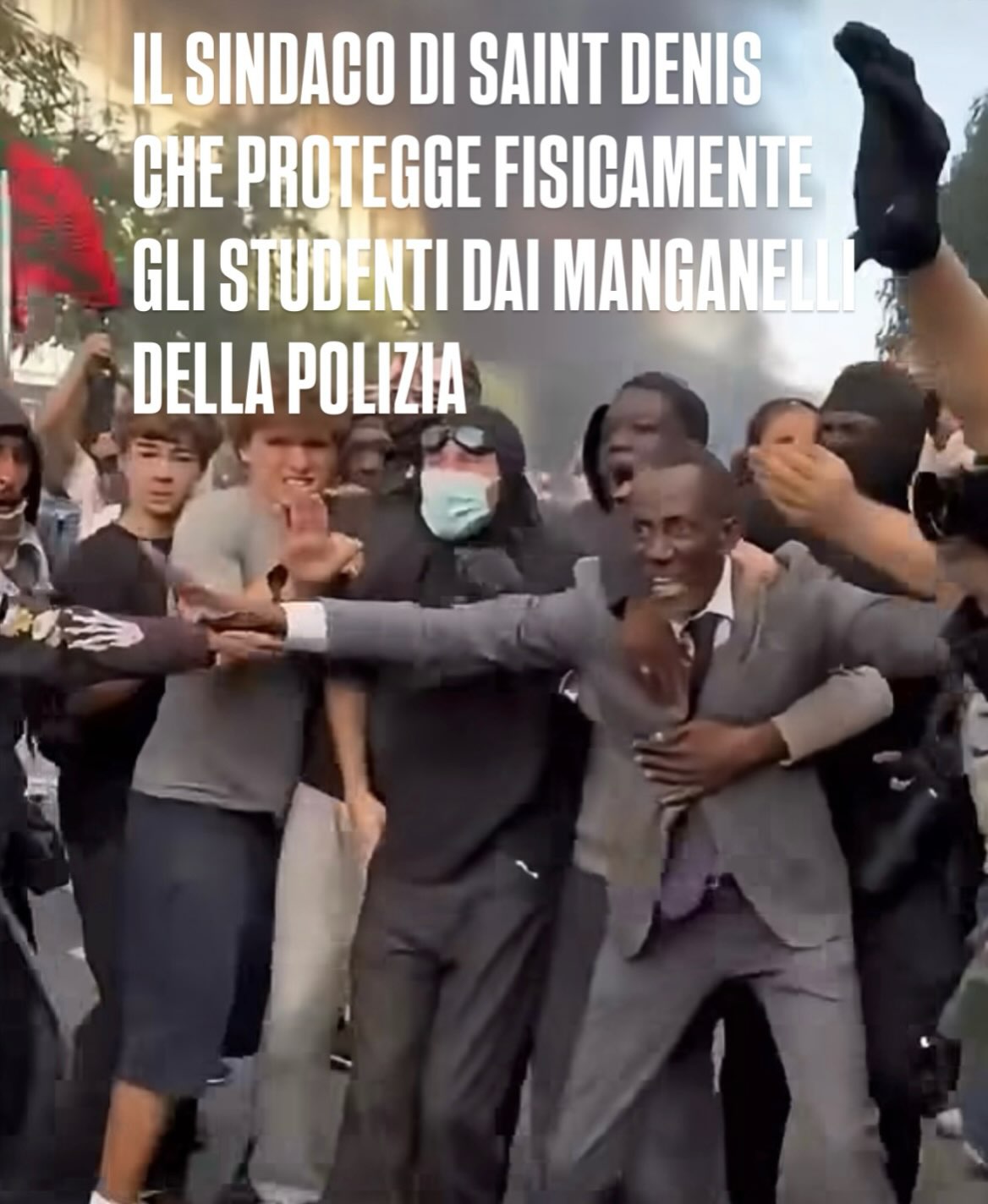
Mayor Bally Bagayoko steps between riot police and student protesters, Paris, October 6 — Video: @brutofficiel (filmed by @remybuisine)
Interviewed by Reuters the next day at his town hall, he was precise about what he had seen. “They had decided to charge and effectively go after the students, many of whom had shown no aggressive behaviour whatsoever toward the police officers,” he said. “The high school children who were in the street could be my children. It is my responsibility to be at their side.” To El País he added: France must answer its young people with “concrete measures, and not with the police” — and there is one way of doing things in wealthy neighbourhoods and another in working-class ones. The republic, the sentence implies, does not police all its children alike — and the children can name the postcodes where the knowledge applies.
The state’s reply to the mayor was administrative and swift. Weeks earlier, before the blockaded Paul-Éluard school, Bagayoko had said that “violence, at a given moment, can be legitimate.” The Paris police prefect referred him to the public prosecutor for alleged incitement to commit an offence. Asked to withdraw the sentence on franceinfo, he refused, in terms that deserve to be quoted whole: “I stand by those words. I do not withdraw them. I do not apologise. But what I am asking for is de-escalation.” “It is the place of an elected official,” he said, “to be beside them.” His enemies circulated a cut video that seemed to show him feeding a fire outside the school; a longer sequence, shown by TF1, shows the opposite — the mayor dragging the burning bin away from the entrance so the flames would not reach the building, applauded by the students, applauding in turn the firefighter who put it out.
Since the weekend, the storm has moved over him in earnest. Bruno Retailleau, the Republicans’ presidential candidate, accuses France Unbowed’s elected officials of having “armed the violence with their slogans,” quoting Bagayoko’s sentence back at him. The president of the Île-de-France region, Valérie Pécresse, proposes to send him a bill for €100,000. The New York Times simply calls him the face of France’s youth protests. Consider what the crisis has produced: the state’s own elected officer, interposing his body between the state’s police and the state’s children, claiming both as his charge. France has a long tradition of the mayor as the republic’s first magistrate and last neighbour. It has rarely staged the contradiction so literally.
The ledger
On Monday the government published its arithmetic: that of a state that lost a weekend. Some 2,400 people were arrested — 2,397 in the detailed count — including a record 855 in Paris alone. Nine hundred and ninety-seven police officers, gendarmes and firefighters were injured, seven seriously. At least 3,000 businesses were damaged or looted. Two people died: a protester, of a cardiac arrest in the middle of the Paris crowd — the prosecutor is investigating — and a 22-year-old police officer in Nantes, struck by a third-party vehicle. Among the civilian injured were two people who lost hands.
Widen the frame and the figures change their meaning. Since September, roughly 7,950 people have been held in police custody. Of them, 6,773 were minors. The majority of the bodies the French state has processed through its cells this autumn have been children’s. The burnings were real, and so were the shopkeepers who defended their life’s work with their own hands. But that ratio is the fact of the crisis, and it will outlast the curfews.
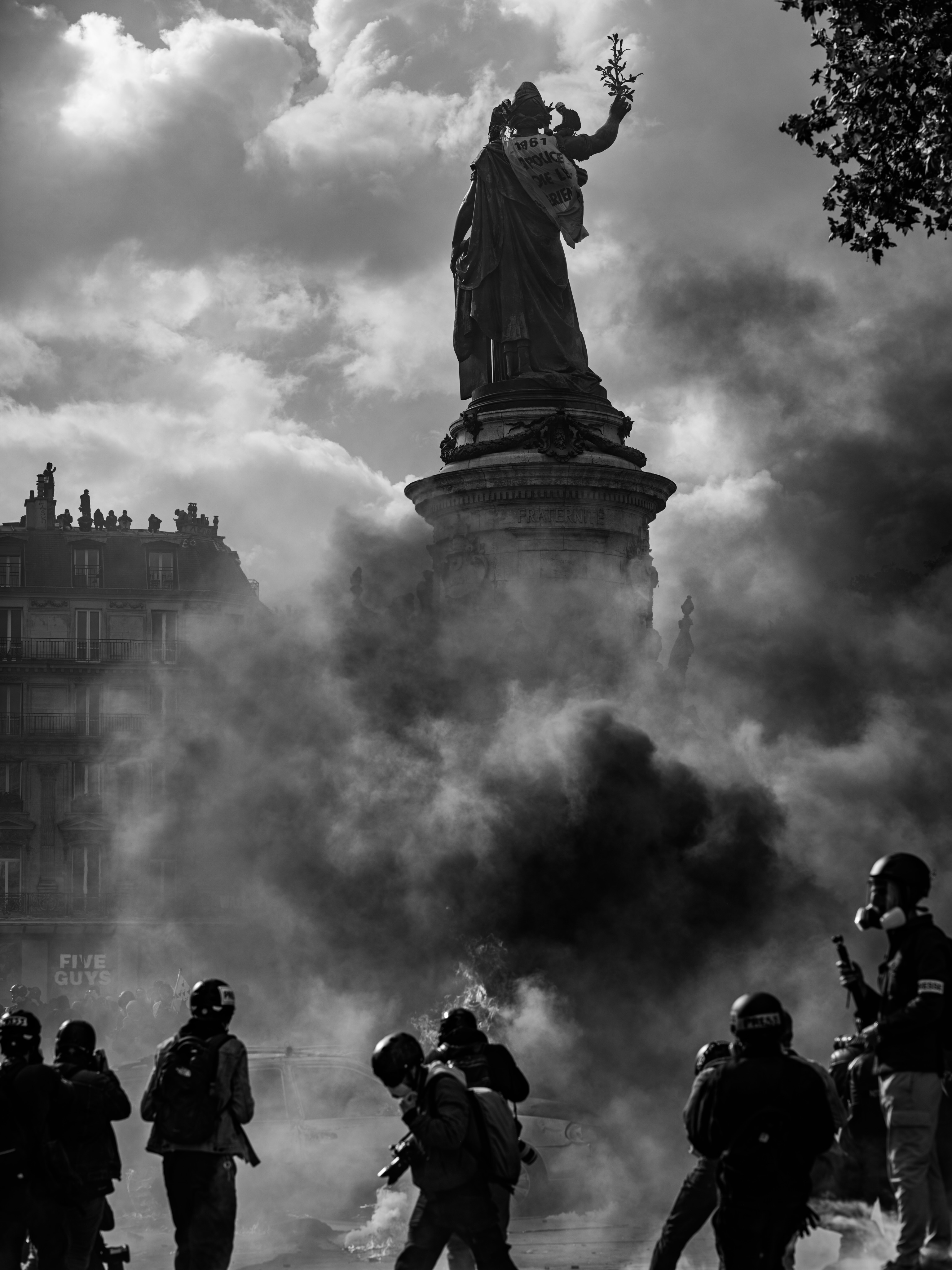
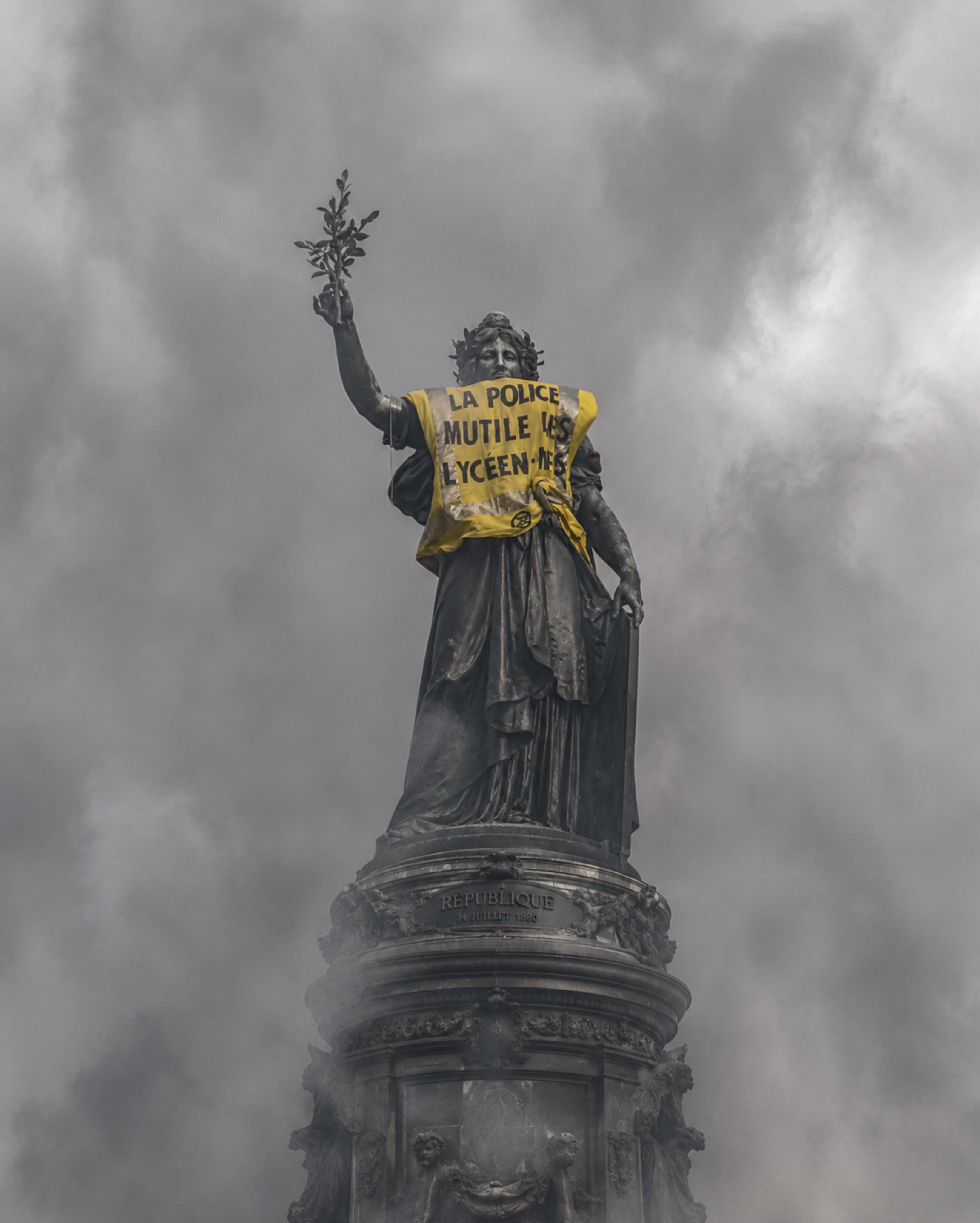
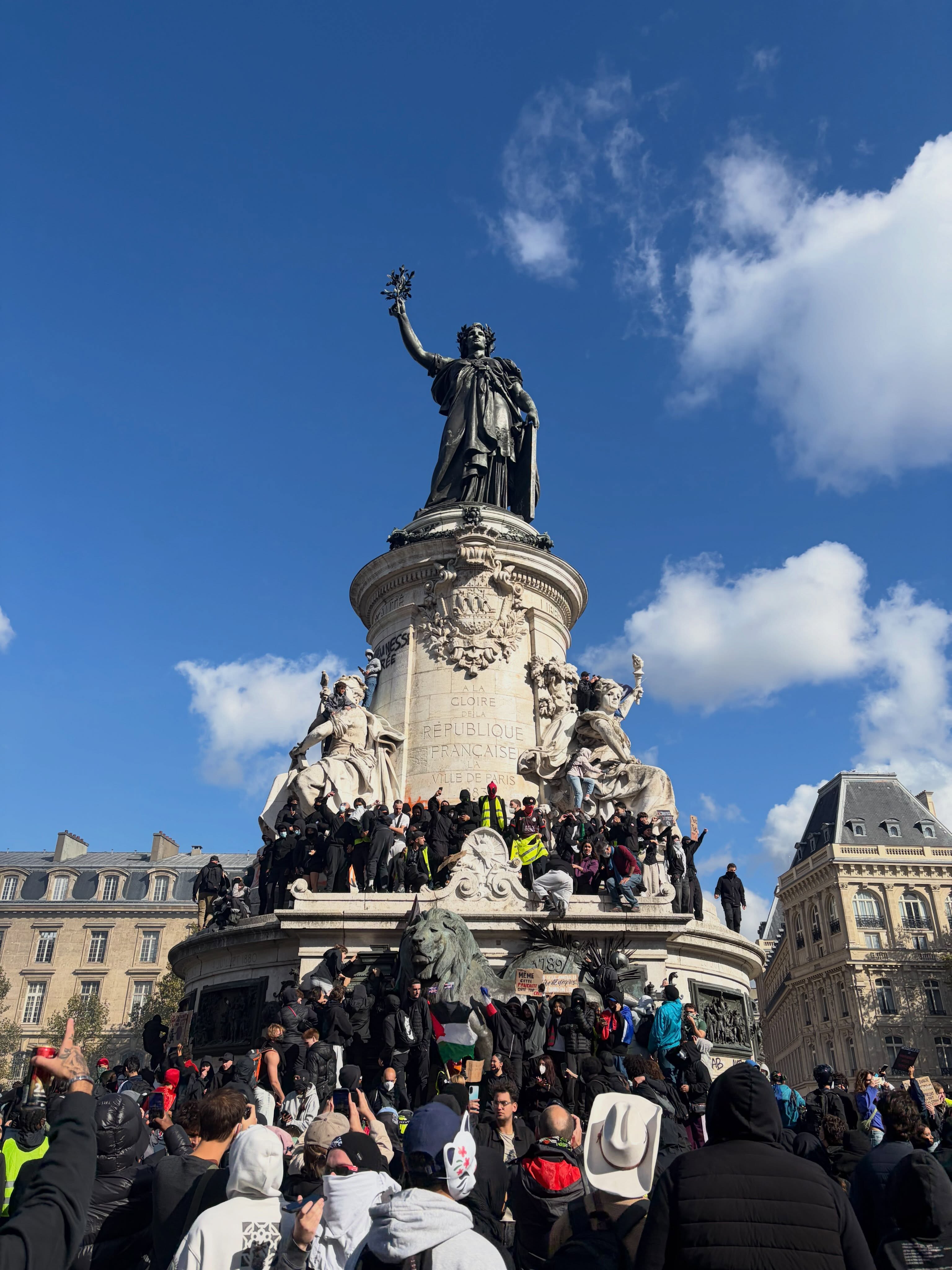
The anthropological eye keeps being drawn to the symbols, because the crowd keeps supplying them. At République, activists climbed the great statue of Marianne and dressed her in a yellow vest — the garment French law obliges every driver to carry, the uniform of 2018 — lettered by hand: La police mutile les lycéen·nes. The police maim high-schoolers. A banner in another photograph from the same square invoked 1961, when Paris police killed Algerian demonstrators in these streets on this same October date. The crowd was conducting a rite of citation, dressing the republic in its own accusations, footnoting itself with the state’s unburied dead.
The state answers
Macron addressed the nation on Sunday evening. He named the public’s feelings for it — “anger” and “shame” — and of the violence he said that nothing justifies it, nothing explains it, nothing excuses it. Those who destroyed would pay; those who looted would pay back. He acknowledged failures of intelligence, demanded complete transparency, affirmed the nation’s support for its police, and said he understood the deep anxiety of the young. He proposed no measure addressed to it. On Monday the Élysée announced he had refused the resignation of his interior minister, Laurent Nuñez, offered the night before — “I am the minister of the interior; I am responsible for everything that happens on the ground” — saying the minister must stay to ensure “continuous command of law enforcement,” and ordering him to deploy new methods against rioters as quickly as possible. Nuñez admitted there had been a “lack of anticipation,” and that in some cities the police had lost control.
The prime minister’s instruments were local and partial. Lecornu asked prefects to impose localised curfews from Monday night — République itself was placed under curfew from eleven, Les Halles from ten; Lyon banned evening gatherings; Marseille banned them for an afternoon; Denain set a curfew of its own. A citywide curfew for Paris was, Lecornu said, “out of the question”; a state of emergency was not ruled out. For the looted, furlough support from Tuesday and a fund; for the mayors, who had jointly demanded to know why “whole swathes of our cities were left without protection,” a promise of diagnosis. For the movement, consultations, beginning this week. For the blame, a theory: Lecornu attributed the weekend to far-left groups seeking “profound unrest” before the presidential election. Mélenchon replied that he should produce evidence, or apologise and stop fanning the flames.
What to watch
The school holidays have begun, which removes the movement’s daily stage; no one knows whether the street keeps its crowd without the classroom to empty into it. The yellow-vest networks have called a second act for Saturday, October 24. Five unions have called a national strike for November 5: pay, public services, jobs. The opposition wants a parliamentary inquiry into how a government with 60,000 officers deployed came to lose its town halls. The bond market, that least sentimental of French institutions, has already voted once, widening the spread over German debt to 146 basis points.
And over everything hangs April 2027. Macron cannot run again. Marine Le Pen, who leads the first-round polling, called the weekend’s grievances “legitimate” even as she blamed the far left for hijacking them. The pension reform waits in its escrow, frozen until the January after the vote — the largest unanswered question in French public life. France has been here in other costumes, and the script is always described as a cycle, as if the country were weather. It is not weather. It is a ledger, kept by both sides, and October 17 was the day the two columns were read aloud at once: what the state says it owes, and what its children say they were promised. The reading is not finished.
Reporting drawn from Reuters, the Associated Press, AFP, Le Monde, Le Figaro, France 24, RFI, El País, BFM TV, franceinfo, Le Parisien, Le Nouvel Obs and CNN, October 6–19, 2026. Photographs from public social posts, credited to their posters; video embedded from the original post. Figures are official counts as published on October 19 and remain subject to revision.



Leave a Reply