
By The Editorial Board
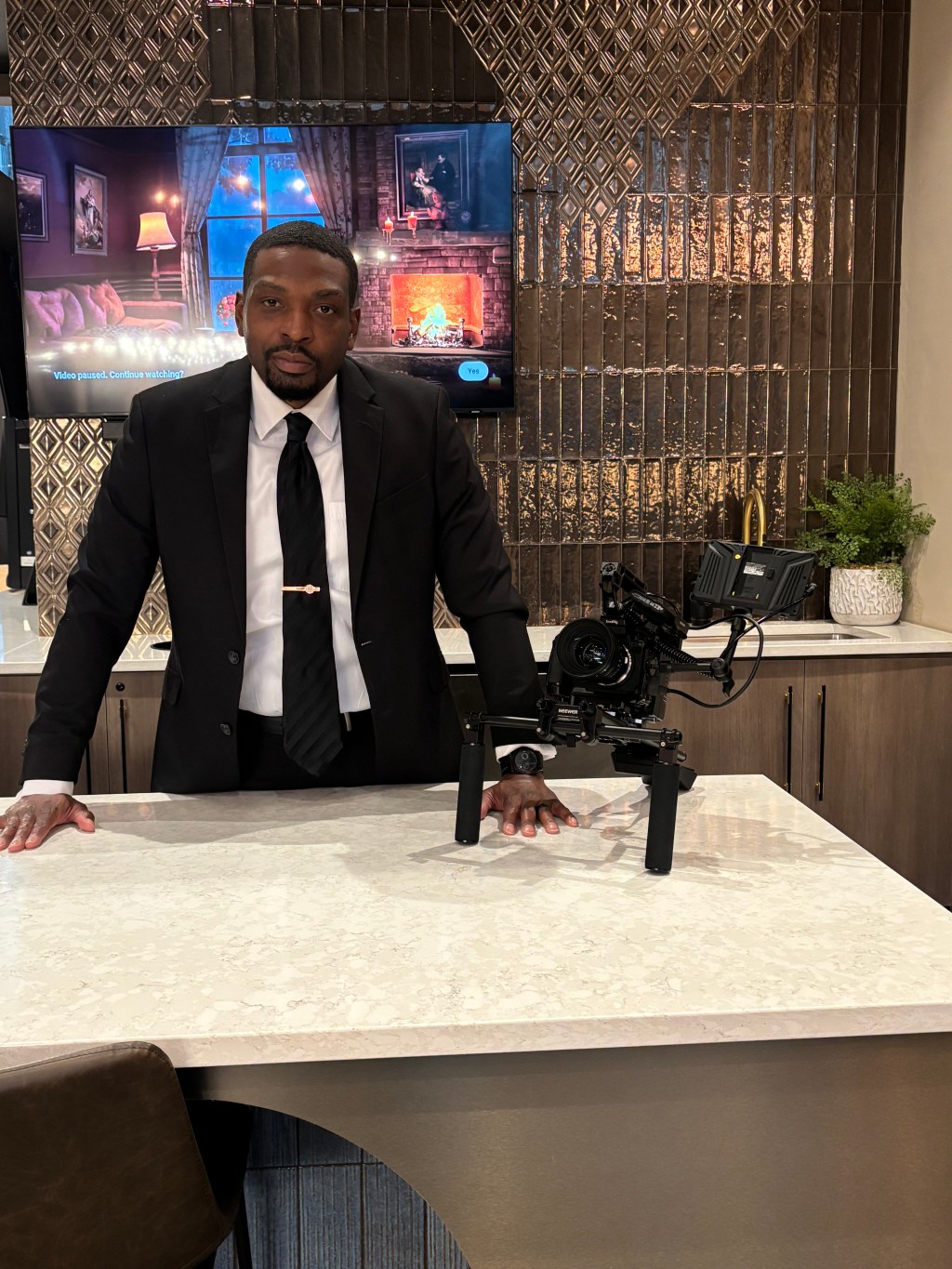
Freddy Long is an accountant. We say that first because he would.
The Carol City native — Miami Carol City Senior High, class of 2006 — audits by day and makes films in whatever hours are left, and when The Grvy sent him fifteen questions this week, he did to them what he does to a ledger: he corrected them.
Two questions came back reworded. Two came back with a suggestion, in italics, that we drop them — we have. Several of our prettier premises came back declined, politely and completely: that a score he once wrote left a story “unfinished being his”; that ingenuity on a $20,000 espionage film amounts to a kind of counterfeiting; that Atlanta is “the so-called Black Hollywood.” He underlined the word counterfeit.
So we are printing the interview the way he returned it — his questions where he fixed them, his answers as he wrote them. Two of his corrections deserve stating plainly, because he insisted on them. First: Freddy Long has never scored a feature film. Not Feel the Burn, not any other. Second: though he claims Carol City everywhere he goes, he will tell you himself it taught him nothing about storytelling — he wasn’t interested in filmmaking back then, and he never went to film school.
What he is interested in is the work. What follows is the work, in his words.
1. You came to directing through the score — you composed the music for Laurie Masi’s Tangled Web and walked away wanting to direct. What did you hear in your own music over someone else’s images that told you the story wasn’t finished being yours?
I simply felt I could do it too. It had nothing to do with ownership of a story. I did not even know what story I wanted to tell then.
2. Your degree is in Economics and your day job is accounting — you wrote Kiki & Dee right before starting as an auditor. Be honest: does the accountant in you make the filmmaker better? What does a Freddy Long production budget spreadsheet look like?
I do not believe accounting makes me a better filmmaker. I created a small workbook with detail spreadsheets that feed the profit and loss. It is very simple to me.
3. You call yourself a disciple of Christopher Nolan’s Following — write the script expecting no money. Feel the Burn is an international espionage film made for $20,000. Walk us through the math of that: what did the $20K actually buy, and what did ingenuity have to counterfeit?
The $20,000 bought wardrobe, locations, props, cast, crew and crafty. Ingenuity has always been a part of filmmaking, so I do not want to minimize resourcefulness and creativity to counterfeit. Per definition everything was fake because it is not real; however, it feels real and immersive. I believe we pulled it off to the best of our ability on Feel the Burn.
4. Feel the Burn was written to shoot in Miami — you knew the tower, the island, the locations. Then life moved you and your wife to Atlanta and the whole map had to be redrawn. What did Atlanta give the film that Miami couldn’t, and what do you still miss?
The Atlanta metro gave me different locations to make the story expansive instead of the majority feeling tropical. One of my favorite locations is a cabin scene out in Ellijay, GA, and that was 100 miles north of Atlanta. I miss my family back home in Miami.
5. LaShay and Vivian — two Black women operatives carrying a spy thriller, written and directed by a man. Where did those two come from, and what did your cast teach you about them that wasn’t on your page?
LaShay (played by LaToya-Patrice Suber) and Vivian (played by Shannyn Stallworth) were simply characters I wanted to bring to life. When you watch — “espionage in this film acts as a backdrop,” like critic Poeticfeels expresses — so the movie is not a traditional spy thriller, nor did I intend for it to be. Being a man writing and directing this film is not revolutionary. Proud Mary, starring Taraji P. Henson, was directed by Babak Najafi, and Atomic Blonde by David Leitch. As far as what I was shown by the cast that was not reflected on the page, I cannot say. They did their job to be what I wanted on the page.
6. You’ve been the cinematographer for other films — Four Birds with Tray Chaney and Brendan Goshay and Widower’s Syndrome for Stephen R. White and Dexter Rolle. What’s the ethic of that partnership? When you’re behind the camera for another director, what do you owe him?
The ethic of the director and DP partnership, as the DP, is you’re a hand and not the main brain. Respect the director’s vision and find creative, practical and safe ways to bring it to life. That is what is owed to the director. Be a guide and offer suggestions instead of just taking over.
7. Kiki & Dee is free on Tubi, Feel the Burn went out through Indie Rights, Four Birds is playing on Tubi, Prime Video, YouTube and other platforms. For the independent filmmaker watching this: what does distribution actually pay, in money and in audience — and which one matters more at your stage?
The pay of distribution and reach to an audience vary depending on the distributor and deal signed. According to some data I skimmed through, most lose money, but that depends on the cost to produce and market your film. At this stage, they both equally matter, because I am an investor in my films and the larger audience brings more eyes to my film and hopefully more money to fund the next film. As an indie filmmaker, you must always factor in costs and plan to market your film. That’s the difference maker nowadays.
8. Your first camera was a Nikon D3200 and your first sets were your cousins. Who from those cousin-film days is still in your credits, and what do you tell a kid in Carol City right now holding his first camera?
Those cousins (Mari, On’tea, and Oscar) are grown up and living their lives. They are in Miami and I am in Georgia. What I will tell any kid — and not exclusively from Carol City — holding their first camera is: respect the craft, seek out videos of behind-the-scenes footage, and read books about filmmaking. As a young filmmaker, I’d recommend Walter Murch’s In the Blink of an Eye: A Perspective on Film Editing first. If a director can think as an editor, then they’ll know exactly what they need on set to convey the story as they intend to.
9. You’ve said you want to try sci-fi horror. Why that door next, and what would a Freddy Long sci-fi horror film have to say?
I like to challenge myself, and science fiction is not just space like Star Wars and Star Trek. Science fiction comprises any and everything that doesn’t exist yet scientifically. I do not know what a Freddy Long sci-fi horror says or doesn’t say. I am in the idea stage. I was going one direction and I recently pivoted to something else.
10. You moved to Atlanta from the city that raised you. Two scenes, two economies of Black film. Where does a filmmaker like you actually get more made?
I do not want to refer to the Atlanta metropolitan area as “the so-called Black Hollywood.” I have a huge respect for the city and metropolitan area for the talented cast and crew it’s provided me. As far as getting stuff made, we all can make a film anywhere. However, Atlanta provides me more locations in the surrounding areas and states to make the stories I want to make.
11. The sequel to Feel the Burn has been talked about but not written. What has to be true — money, audience, story — before you put pen to paper?
Story and challenge is most important to me. The capacity of my involvement in any sequel is not guaranteed at this time. When I write anything, I write with the intent for the story to conclude.
12. You and Othello have been arguing this for a year in his DMs, so let’s put it on the record: you say real people will always trump AI’s version — that AI has no imagination and no instinct. He says traditional filmmaking is becoming like jazz, something only certain people will sit for. A year later, where do you actually stand — and what did his AI work get wrong that a set never would?
I stand firm that humans like to watch other humans, and we can feel the human performance, good or bad, at this current iteration of AI filmmaking. I’ve incorporated AI music because we could not afford a composer. The box office shows that billions of dollars’ worth of moviegoers will sit through traditional filmmaking, with Spider-Man and The Odyssey taking 1 and 2 this year so far — $2.5bn and $1.8bn, respectively.
13. Finish this sentence the way you’d want it quoted back to you in ten years: “Freddy Long makes films because…”
…he loves to, and they’re loved by his fans.
QUICK-FIRE
- Miami or Atlanta — to shoot? Depends.
- Nolan film you’d erase from everyone’s memory so you could watch it first again? Inception.
- Budget no object: your dream camera package? Alexa 65.
- Score your own film or hire a composer? Hire a composer.
- Tubi, theater, or festival premiere? Theater.
- One Carol City spot everybody should eat at? Don’t know.
- The Wire or Rhythm & Blood set — tougher shoot day? The Wire.
Freddy Long is the owner-director of photography of Victory Mills (victorymills305.com), based in Atlanta and South Florida. Kiki & Dee is free on Tubi; Feel the Burn is available through Indie Rights; Four Birds is playing on Tubi, Prime Video and YouTube. His cinematography reel: https://youtu.be/o5Va3yfe4as



Leave a Reply