
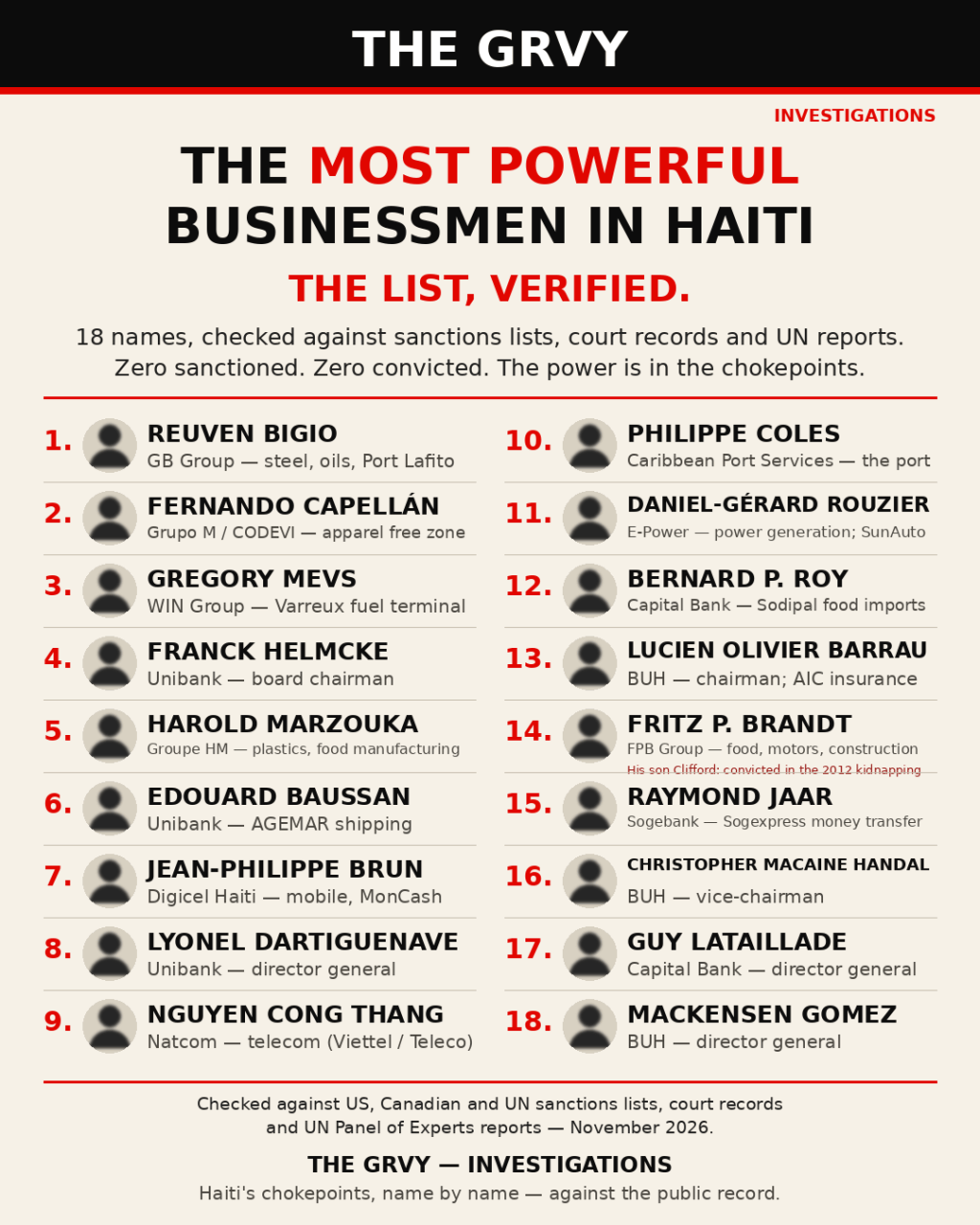
A viral ranking gave eighteen men two-decimal power scores and no sources. We checked every name against the sanctions lists, the court records, and the UN’s own experts. The record is stranger than the rumor: nobody on the list is sanctioned, nobody is convicted — and the men the West has actually designated aren’t on it.
By Nadège Pierre, Caribbean Correspondent — Port-au-Prince
The List
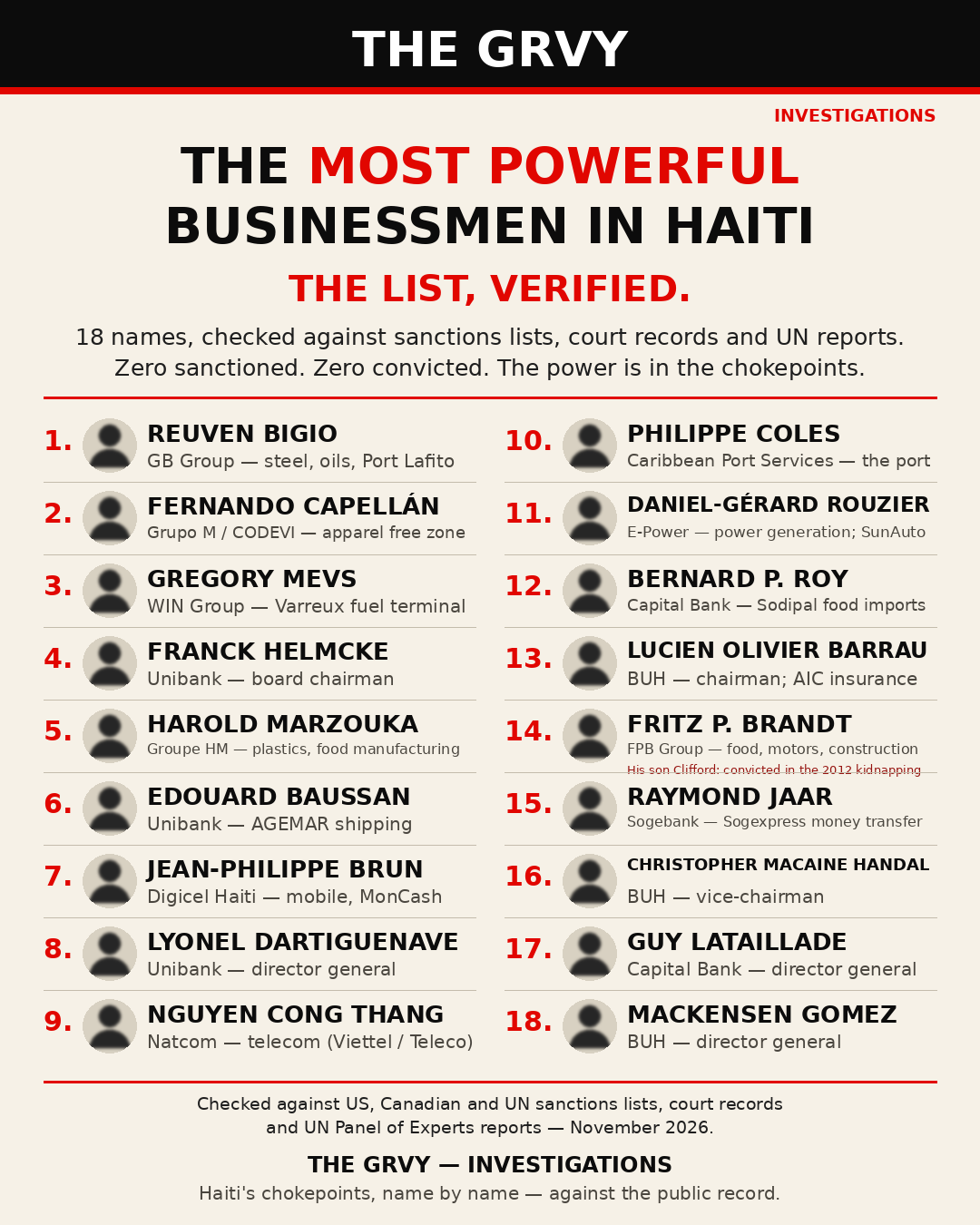
The graphic is handsome, in the way of things built to travel. Eighteen portraits in two columns — two of them silhouettes — each with a name and a score carried to two decimal places. Reuven Bigio, 95.80. Fernando Capellán, 93.70. Down through bankers, port operators, a telecom chief, to Mackensen Gomez at 76.20. The title: The Most Powerful Businessmen in Haiti. The source: ETC — Explaining The Caribbean, an Instagram account of some 93,000 followers, location-tagged New York, with no website, no masthead, no editor’s name, and no published methodology for the Haiti ranking anywhere in its twenty slides. Asked in its own comments, the account clarified only that the index “measures economic power, not nationality.”
The scores were never the story. The story is what got pasted on top of them. Reposting the graphic, the activist and professor Danny Shaw supplied the caption that carried it around the world: “The true gangsters in Haiti wear ties and have duel [dual] U.S./Haitian passports. They are the ones who financed and armed the gangsters in flip flops to attack historic communities of resistance.”
It is a serious accusation, aimed at eighteen named men. So we did the unfashionable thing: we checked. Every name on the list, against Canada’s sanctions schedule for Haiti, the US Treasury’s designation lists, the State Department’s named actions, the UN Security Council’s Haiti sanctions list, and the published reports of the UN Panel of Experts — plus court records and the press in English, French, and Spanish. What follows is what the record actually says. It clears most of these men. It convicts none of them. And it points, with some precision, at the men the list left off.
The Men Who Aren’t There
Start with the finding that rearranges everything else: zero of the eighteen appear on any designation list we checked. Not one is sanctioned by the United States, Canada, or the United Nations. Not one has been convicted of anything. One was charged, historically, in a case that was dropped. Five carry allegations of varying weight. Twelve — including the men ranked first and third — have no adverse record we could find.
Now consider the men Western governments have designated. Canada’s Haiti sanctions schedule names, among its economic elites, Gilbert Bigio — sanctioned on 5 December 2022, in Ottawa’s words, because he and two others used their elite status “to protect and enable the illegal activities of armed criminal gangs, including through money laundering and other acts of corruption.” It names Reynold Deeb, Sherif Abdallah, Carl Braun, Jean Marie Vorbe, Marc Antoine Acra, André Apaid. The United States moved against Pierre Réginald Boulos, arrested by ICE in July 2025. Not one of these men is on ETC’s list.
The two lists touch only by blood and by boardroom. The sanctioned Bigio is Gilbert — who died this September in Florida, aged 91. The man ranked first, at 95.80, is his son Reuven, head of the GB Group conglomerate: steel, edible oils, construction materials, and Port Lafito, Haiti’s first private deep-water port. No designation against Reuven Bigio exists on any list we searched, and printing his father’s under his name would be an error with a lawyer attached. The same pattern repeats down the ranking. Canada designated Carl Braun, of Unibank, for “acts of significant corruption” in September 2023; Braun resigned from the bank’s board a month later. The list instead ranks three of Braun’s Unibank colleagues — board chairman Franck Helmcke, first vice-chairman Edouard Baussan, and director general Lyonel Dartiguenave. A private complaint naming all three, alleging fraud and money laundering among a litany of charges, was put before a Haitian judge in December 2024. On 13 January 2025 the judge refused it outright: no grounds to investigate, “for absence of an offence.”
Even the traps in the record are instructive. Reuven Bigio and Gregory Mevs, ranked third, both appear in a 1994 US Treasury file — marked with the asterisks that file itself defines as Haitians blocked by residency under the coup-era embargo, a blanket measure deleted that October. A careless researcher would call them sanctioned men. A careful one reads the footnote.
The One Conviction
There is exactly one kidnapping conviction in this story, and it belongs to a man who is not on the list. He is the son of the man ranked fourteenth.
On 16 October 2012, Nicolas Moscoso, 24, and his sister Coralie, 23 — children of Robert Moscoso, a figure at Sogebank — were kidnapped in Pernier by men wearing police uniforms. The ransom demand was $2.5 million. Six days later, judicial police arrested Clifford H. Brandt at the offices of Haitian Motors in Delmas 2, the Brandt family’s car company. Brandt led police to the victims, and they were freed. In August 2014 he escaped in the Croix-des-Bouquets prison break — 329 inmates out, in an attack alleged to have been staged to free him — and was recaptured two days later near the Dominican border. His first conviction, eighteen years in 2016, was cancelled by the Court of Cassation on procedural grounds. At the retrial in Gonaïves, in December 2018, he admitted sponsoring the kidnapping: revenge, he said, over a US$2 million government contract the Moscoso family had won. On 11 December 2019 the court sentenced him to twenty years.
That is the son’s record, entire and adjudicated. The father’s is a different document. Fritz P. Brandt, ranked 77.30, runs the FPB Group — food manufacturing, construction, agriculture, and Haitian Motors itself. His own brush with the law is a 2007 customs-fraud case: arrested with his son David over allegedly falsified payment slips on a $100,000 truck, freed after three months “for lack of evidence,” the case dropped, in a US embassy assessment, by 2009. No charge, conviction, or sanction connects Fritz Brandt to his son’s crime. (Contemporaneous Associated Press reporting identifies Clifford as Fritz’s son; some later profiles assign the paternity differently — we print the AP line as the best-supported.) The list’s most damning association is a genealogy. Everything else about it has to be earned name by name — which is where the list, and the rumor around it, mostly fails.
Chokepoints
What ETC measured, beneath the decimals, is real. It is just not crime. It is plumbing.
Nine of the eighteen are bankers — three from Unibank, three from the Banque de l’Union Haïtienne, two from Capital Bank, one from Sogebank. Whoever intermediates a country’s deposits and its diaspora’s remittances will always look powerful, because they are. The rest of the list is a map of the gates through which Haiti’s life passes. Philippe Coles, ranked tenth, presides over Caribbean Port Services, the private operator of the state-owned Port-au-Prince port, through which roughly 80 percent of Haiti’s inbound containers move. CPS got the port in October 2015 by a no-bid contract, and on 4 December 2023 the concession was renewed for twenty-seven years. In the summer of 2025 the renewal became a crisis at the summit of the transitional state: the council’s president, Fritz Alphonse Jean, alleged that a presidency statement blessing the deal had been issued without his consent, by a coerced staffer, and demanded judicial review. A year earlier, after gangs stormed and looted his terminal, Coles had described his own concession to the Washington Post: “It’s total paralysis right now. The gangs have the control. They have the upper hand now.” Gregory Mevs’s family group runs the Varreux terminal, which stores more than 70 percent of Haiti’s fuel; when gangs blockaded it in the spring of 2024, the country began to stop. Telecom is a duopoly held by two list members: Jean-Philippe Brun runs Digicel Haiti and its MonCash money network, and Nguyen Cong Thang — the list’s Vietnamese name, and the answer to its most-asked question — directs Natcom, the joint venture between Haiti’s Teleco and Viettel, the Vietnamese military’s telecom group, which by the regulator’s latest figures has overtaken Digicel to become the country’s largest network.
Note the posture of these men in the UN’s own reporting. The Panel of Experts names CPS not as a gang financier but as a gang target — a terminal operator extorted by the armed groups. It describes Varreux attacked, looted, blockaded. In 2021 the Associated Press reported that Jimmy “Barbecue” Chérizier allegedly demanded $500,000 a month from a Mevs executive; she refused to pay, and the AP noted she “has never been formally accused” of anything. In the verified record, the men at the gates appear less as the gangs’ bankers than as their hostages and counterparties — which is its own indictment, of the arrangement rather than the men. Even the allegations that do exist sit at this structural level. Fernando Capellán, ranked second, is a Dominican whose CODEVI free zone employs some 17,000 to 20,000 Haitians at Ouanaminthe; his adverse record is a documented 2004–06 labour dispute — the alleged firing of a newly formed union committee, the alleged displacement of farmers, a World Bank loan conditioned on remediation — reported in US diplomatic cables, never charged. Daniel-Gérard Rouzier, ranked eleventh, was rejected as prime minister by parliament in 2011 amid allegations that were never adjudicated; his power plant, pointedly, was won by international tender. Jean-Philippe Brun faces a live judicial investigation into alleged data theft and insurance-premium misconduct in which, reporting stresses, guilt has not been established. And the list’s silhouettes turn out to be quiet men, not hidden ones: Harold Marzouka’s manufacturing family appears in the record as a kidnapping victim in 2023; BUH’s Mackensen Gomez is a career executive who owns no empire at all.
The Rumor
In September 2025, word spread through Haitian media that the United States had allegedly sanctioned Philippe Coles and Edouard Baussan and allegedly revoked their visas — the very claim that makes Shaw’s caption feel confirmed. We traced it. It begins with a single social-media post by Radio Télé Métronome citing an unnamed “diplomatic source,” with Baussan’s name garbled in the telling. Two outlets echoed it. No US government source — not Treasury, not State, not any wire service — has ever named either man, and Washington does not publicly name visa revocations as a matter of practice, which makes the claim not false, exactly, but unfalsifiable: a fact-shaped object that cannot be checked and therefore cannot be killed. It now circulates as settled truth. Baussan carries a genuinely serious allegation — a Haitian police report, cited by one outlet in December 2025, placing him near an alleged arms-trafficking network — and it deserves print exactly as what it is: an allegation, uncharged, from a single source. What neither man carries, on any primary record we could find, is a sanction.
This is how the information ecology of a crisis works. The vacuum left by unexplained scores gets filled by captions; the captions get filled by rumors; and the rumors, repeated enough, acquire the texture of findings. A federal court in Florida once awarded a man named Stanley Handal $1.15 million after a newspaper placed him inside the Brandt kidnapping network — the court held the claims false and defamatory. He is not Christopher Handal, the BUH vice-chairman ranked sixteenth here, against whom we found no adverse record at all. Nor is Raymond Jaar of Sogebank, ranked fifteenth and likewise clear in our searches, the Rodolphe Jaar who is serving a US life sentence for his role in the assassination of President Jovenel Moïse; no relation between them was established in any source we found. In Haiti’s small elite, a surname is not evidence. It is barely an address.
What Power Is
So: eighteen men, no sanctions, no convictions, one dropped charge, and a son in prison for kidnapping whom the list does not name. Does that acquit the class Shaw indicted? Not quite. It relocates the charge.
The verified scandal is not that Haiti’s chokepoints are held by criminals. It is that they are held at all — that a country’s main port can be handed to a private operator without a tender and renewed for twenty-seven years while the state’s own council president cries coercion; that 70 percent of its fuel sits in one family’s terminal, besieged; that its largest phone network answers, at one remove, to a foreign army; that the bloc these men form — the Institut Macaya, which counts Bigio, Coles, and Handal among its members — registers lobbyists in Washington and sits close to the transitional state. None of that requires a gang payroll. It requires only contracts, concessions, and time. The men Canada actually sanctioned operated in the same world; most of them simply never made the graphic.
Power in Haiti, on the record, is not the power to order a kidnapping. It is the power to be the gate — and to have the gate renewed. The ties are real. The record, checked name by name, is the only honest way to say what they’re tied to.



Leave a Reply