
By Carmen Delgado, Art Editor
Ten works. That is all it takes.
Basquiat: Figures, Signs, Symbols, on view now at Pérez Art Museum Miami, gathers ten masterworks by Jean-Michel Basquiat from the Kenneth C. Griffin Collection — nine paintings and one sculpture — and makes its case quietly, by concentration. It is the largest presentation of Basquiat’s work ever staged in Florida, and it does not feel small for a second. It feels like standing close to a language while it is still being invented.
A vocabulary in three words
The exhibition’s title is its argument. Basquiat painted in figures, signs, and symbols the way other artists paint in color — and PAMM, organizing the show around those three recurring elements, lets you watch the grammar assemble itself. The human figure comes first: skeletal kings and boxers and saints, bodies that are also diagrams, anatomy learned from childhood museum visits and from Gray’s Anatomy and never unlearned. Then the signs: the crossed-out words, the lists, the © symbols and crowns and trademarks, language treated as both message and erasure — write it, strike it, make you read it twice. Then the symbols, the private mythology laid over the public one: comic books and corporate logos, bebop and boxing, Renaissance anatomy and the street outside the studio, all remixed into a single restless surface.
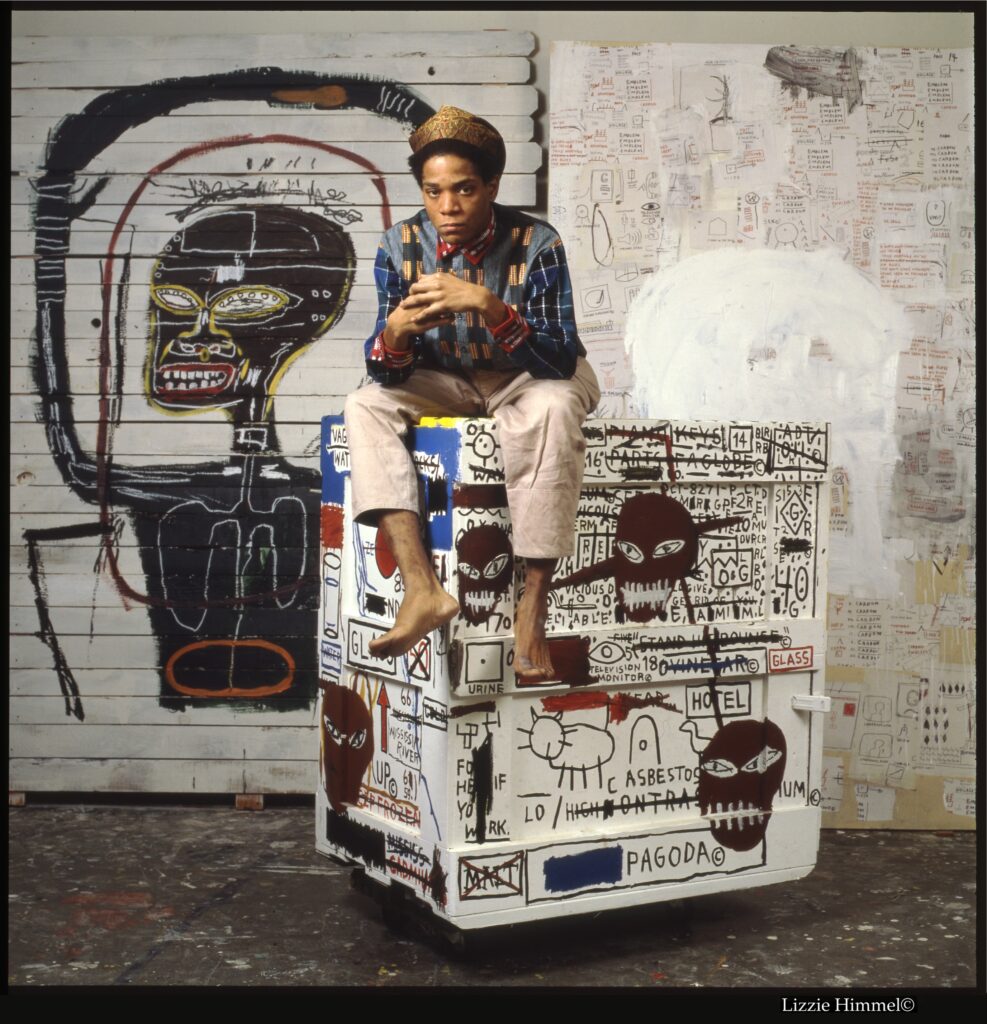
Among the ten works is the show’s quiet thunderclap: the iconic Untitled of 1982, the great skull painting that reset the auction record for an American artist at $110.5 million. In reproduction it is famous. In person it is something else — less an image than a weather system. And the tenth work, the painted “Box” sculpture of 1985, may be the most Basquiat object in the building: a three-dimensional surface he covered in his own handwriting, as if a painting had decided to stand up.
The Miami of it
There is a homecoming folded into this show, even if Basquiat never lived here. The child of a Haitian father and a Puerto Rican mother, raised in Brooklyn on museum trips and downtown noise, Basquiat built his vocabulary out of exactly the mixture Miami runs on — Caribbean memory, Spanish and English in the same breath, high art and street vernacular refusing to stay in their assigned rooms. To see these paintings on Biscayne Bay, in a museum that has made the art of the Americas and the African diaspora its mission, is to see them in the one American city where their references need no translation.
The timing does the rest. The exhibition runs through June 6, 2027, which means it will be standing right there during Miami Art Week this December — a ten-minute walk of the spirit from the fair tents and the convention center, ten originals deep, admission the price of a museum ticket. When the art world descends on this city next month with its booths and its price lists, the strongest room in Miami may be the quiet one on the bay, where the work of a painter who died at twenty-seven is still out-arguing everyone.
Franklin Sirmans, PAMM’s director, organized the exhibition with Megan Kincaid, curator of the Griffin Collection, and an illustrated publication accompanies it. Go before the crowds discover it in December. Go twice.
Exhibition details
Basquiat: Figures, Signs, Symbols
Pérez Art Museum Miami (PAMM), 1103 Biscayne Blvd, Miami, FL 33132
On view through June 6, 2027
Hours: Fri–Mon 11 AM–6 PM; Thu 11 AM–9 PM
Included with museum admission · pamm.org
Photo: Jean-Michel Basquiat, Great Jones Street studio, Untitled (“Box” sculpture), 1985. Photograph © Lizzie Himmel. Artwork © Estate of Jean-Michel Basquiat. Courtesy Pérez Art Museum Miami.





Leave a Reply