
By Isnel Othello
One hundred years ago, the political artwork was a wall, a poster, a photograph in a newspaper — something made to be seen by strangers, in public, whether they wanted to see it or not. A century later it can be a candy pile, a crack in a museum floor, a flag, a projection on a statue scheduled for removal. The forms changed. The job did not. Political art is the record of what power did and what people answered, kept in images when the official record lied, stalled, or looked away.
We built this list the way The Grvy covers everything: the canon is a starting point, not a fence. Guernica is here, and it has company — murals from Mexico City and Los Angeles, famine sketches from Bengal, posters smuggled out of Botswana, photographs carried out of apartheid South Africa at the risk of a life, cartoons drawn in exile for a country at war with itself. Roughly a third of these works come from outside the United States and Europe, and more than a quarter are by women, because that is where a century of political art actually happened — everywhere, all at once, usually against somebody’s orders.
A note on method: every entry was checked against museum and reference sources for artist, title, and date. Where a work’s dating is genuinely a range, we print the range. And a warning, offered in good faith: this list argues. It does not settle. Reasonable readers will fight over the omissions, and we hope they do — the fighting is the tradition these works belong to.
The 1920s
1. The Pillars of Society (1926) — George Grosz. Weimar Germany’s ruling order — general, judge, clergyman, industrialist, journalist — rendered as bloated pigs at a trough. Grosz, who had seen the trenches, drew the class that sent men to them and profited twice: first from the war, then from the peace.
2. Metropolis (1927–28) — Otto Dix. A triptych of Weimar nightlife: jazz and champagne in the center panel, war cripples and prostitutes pushed to the margins on either side. Dix’s point is architectural — the glittering city is quite literally built on the men it used up and discarded.
3. Workers’ Parade (1926) — Tina Modotti. Mexican workers march under union banners, shot from within the crowd rather than above it. Modotti, an Italian immigrant working in post-revolutionary Mexico, made photography a form of organizing; the camera here is not observing the movement, it is marching in it.
4. Woman with Flag (1928) — Tina Modotti. A woman marcher carries a union banner, her face half-shadowed by its folds. In one frame: labor, womanhood, and revolution composed as a single figure. It remains one of the defining images of the Mexican left between the wars.
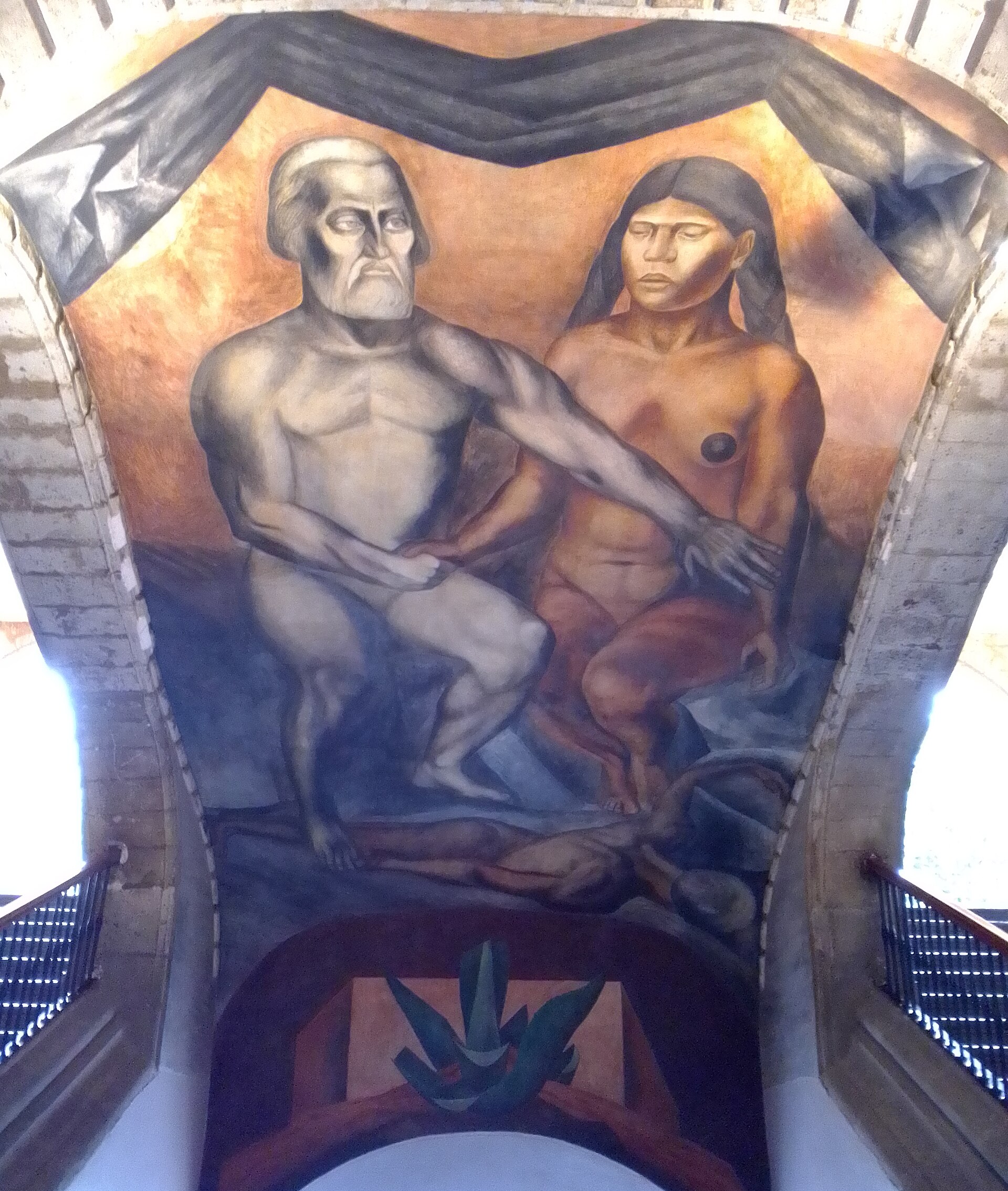
5. Cortés and Malinche (1926) — José Clemente Orozco. The conqueror and his Indigenous interpreter sit nude as a grim Adam and Eve, Cortés’s foot resting on a dead Indigenous man. Painted for a Mexico City school in the mural movement’s first years, it refuses every romance of the conquest — this founding couple is an occupation.
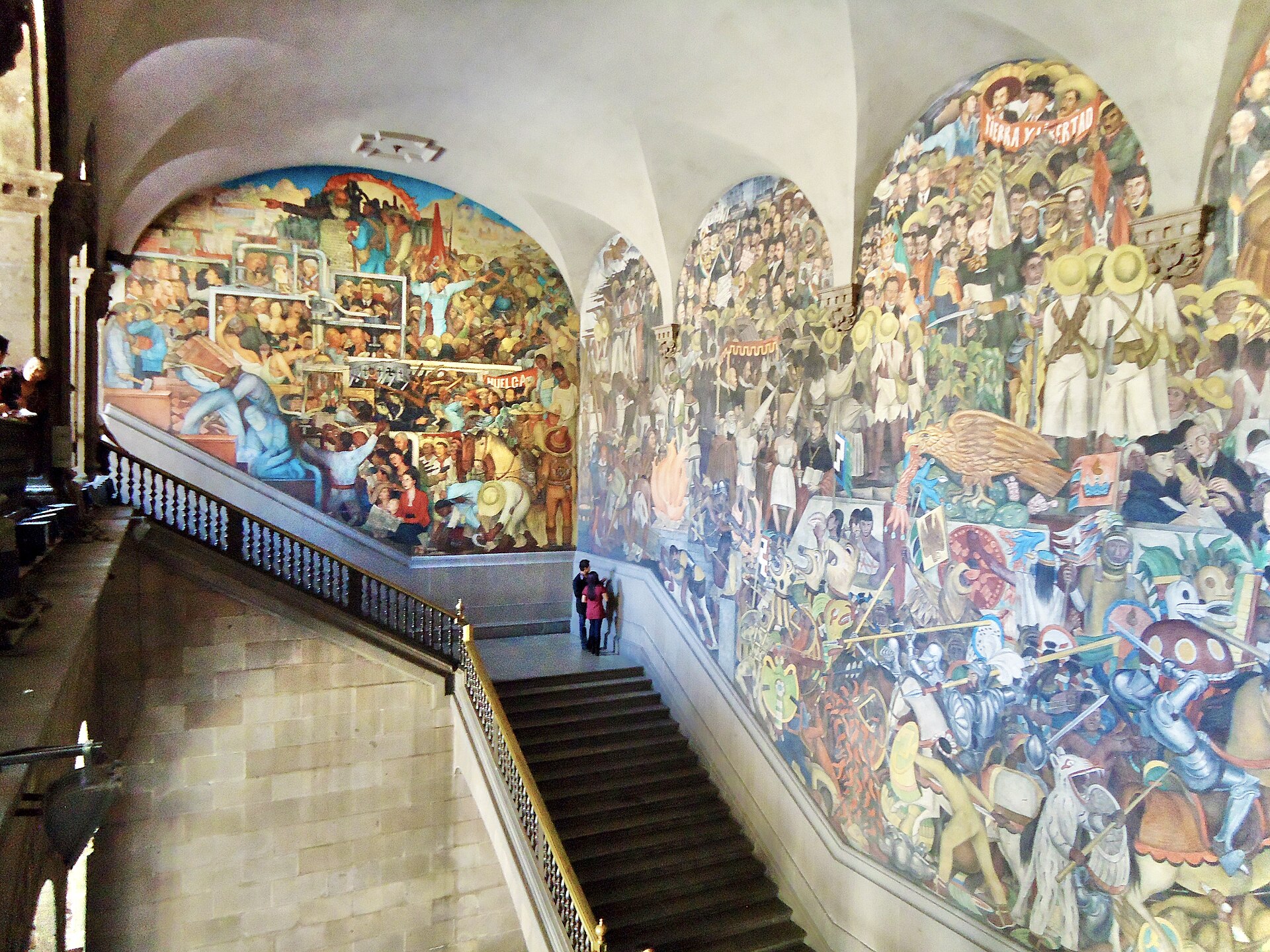
6. The History of Mexico (begun 1929) — Diego Rivera. The National Palace stairway becomes a national argument: conquest, colonization, revolution, and the hoped-for future stacked in fresco across centuries. Whatever its propaganda brief, its scale reset what a public wall could be asked to hold.
7. The Defense of Petrograd (1928) — Alexander Deineka. Painted in a single week for the Red Army’s tenth anniversary: volunteers march out along the bottom of the canvas while the wounded file back across the top. Revolution rendered as a cycle of bodies — austere, rhythmic, and honest about the cost in a way later Soviet art rarely was.
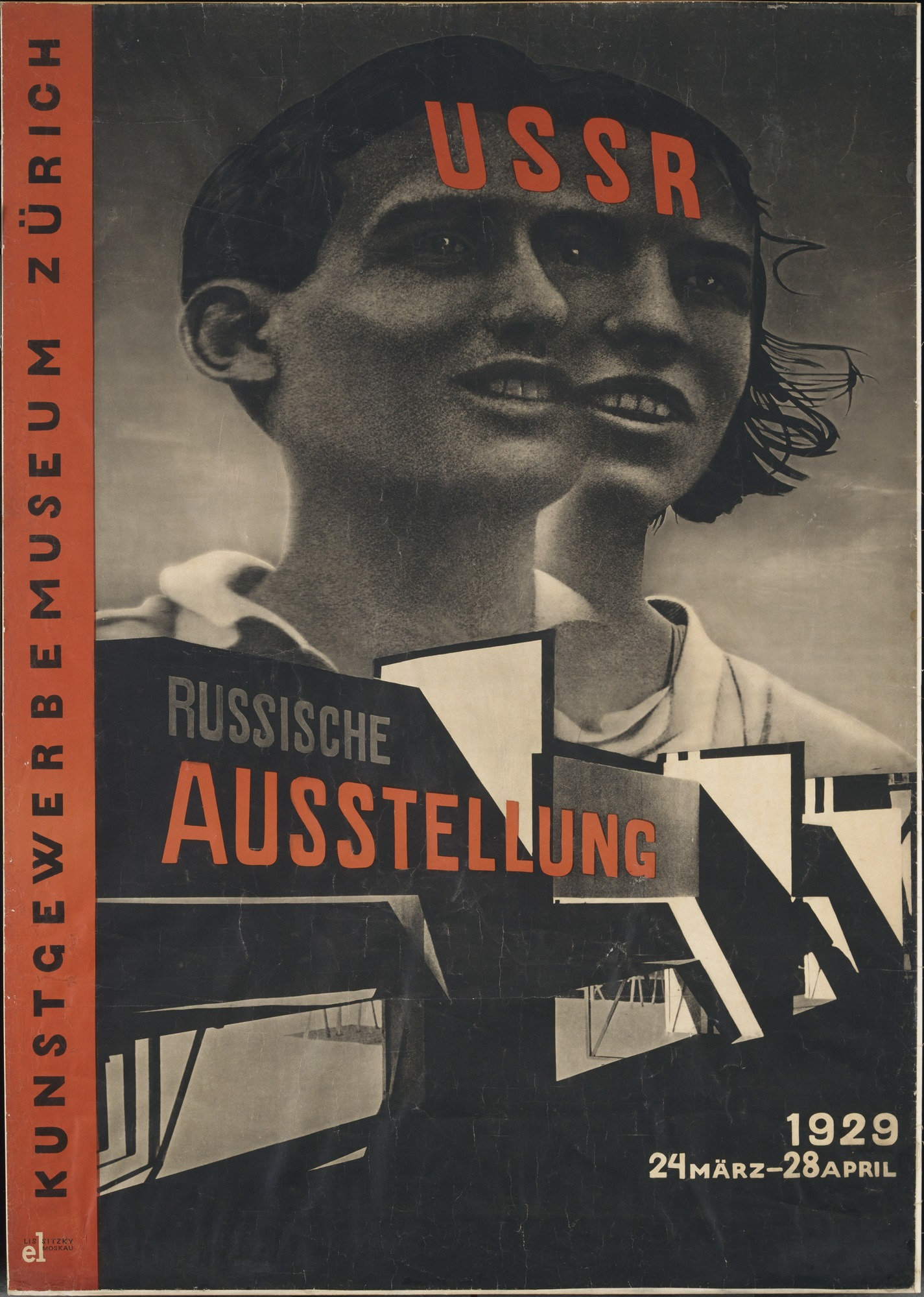
8. USSR Russische Ausstellung poster (1929) — El Lissitzky. A young worker’s upturned face, “USSR” stamped across the forehead, advertising the Soviet exhibition in Zurich. Constructivism as export goods: the poster sold a new state to a skeptical West using nothing but photography, type, and confidence.
9. Egypt’s Awakening (1928) — Mahmoud Mokhtar. A peasant woman lifts her veil beside a rising sphinx, in granite, at the entrance to Cairo. Inaugurated a decade after Egypt’s 1919 revolution, it fused pharaonic and modern Egypt into a single national body — sculpture as a declaration of independence still being negotiated.
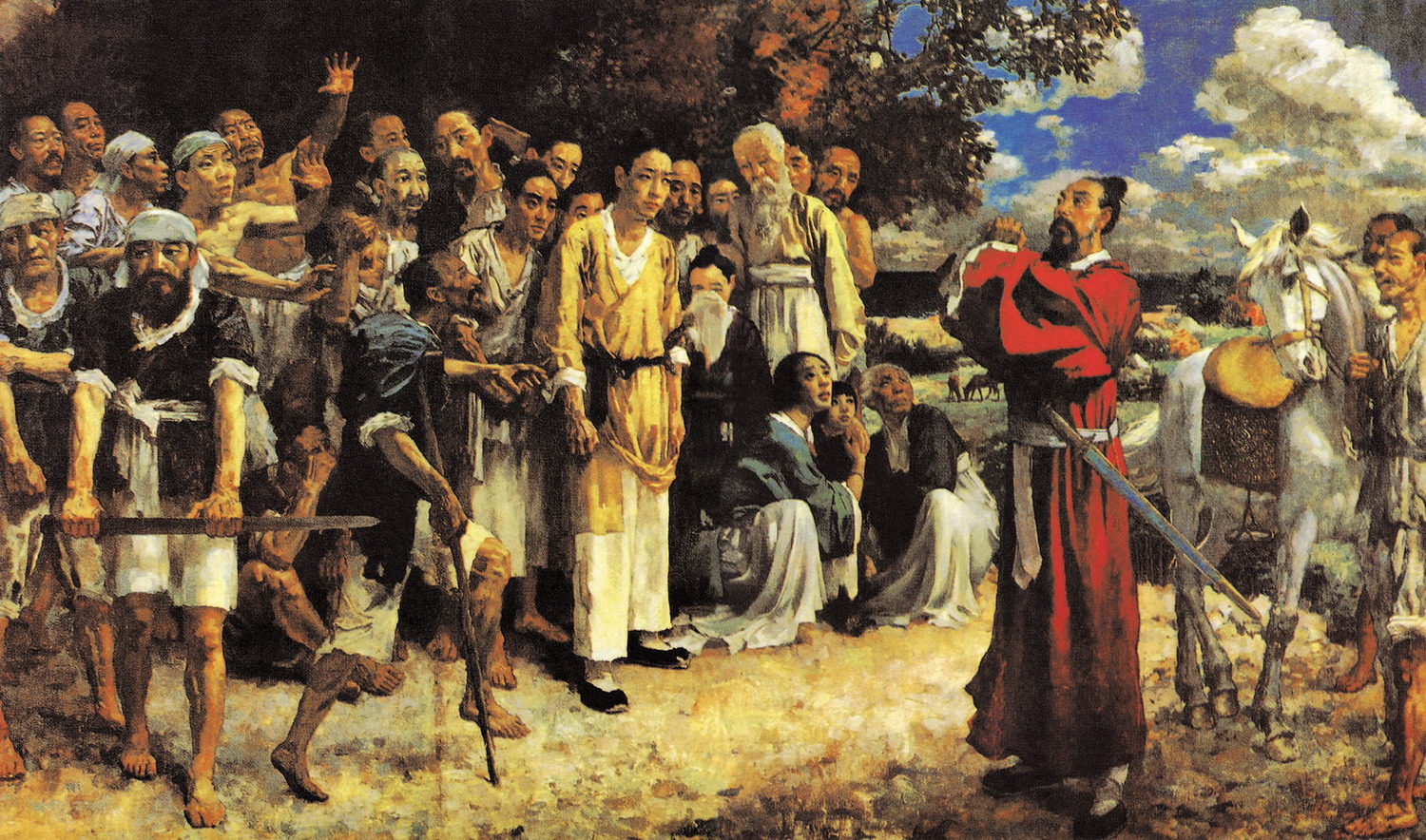
10. Tian Heng and His Five Hundred Followers (1928–30) — Xu Beihong. A Chinese general and his loyal men choose death over surrender — an ancient story painted, unmistakably, for a China then being carved up by warlords and foreign powers. Xu’s monumental history painting announced that Chinese art would answer national humiliation at full scale.
The 1930s
11. Let Us Fulfill the Plan of the Great Projects (1930) — Gustav Klutsis. Photomontage workers stride across a construction site the size of a landscape, building socialism by hand and crane. Klutsis believed the poster was the era’s true public art; the state he served later executed him in the purges his images never imagined.
12. The Passion of Sacco and Vanzetti (1931–32) — Ben Shahn. A gouache series on the executed anarchists, their coffins watched over by the respectable committee that failed them. Shahn turned a Massachusetts courtroom into an American passion play — and an enduring indictment of justice administered by class.
13. Adolf the Superman (1932) — John Heartfield. A photomontage X-ray: Hitler saluting, a spine of gold coins visible down his throat, printed on the cover of a mass-circulation workers’ magazine. Before the world had language for what was coming, Heartfield showed exactly who was paying for it.
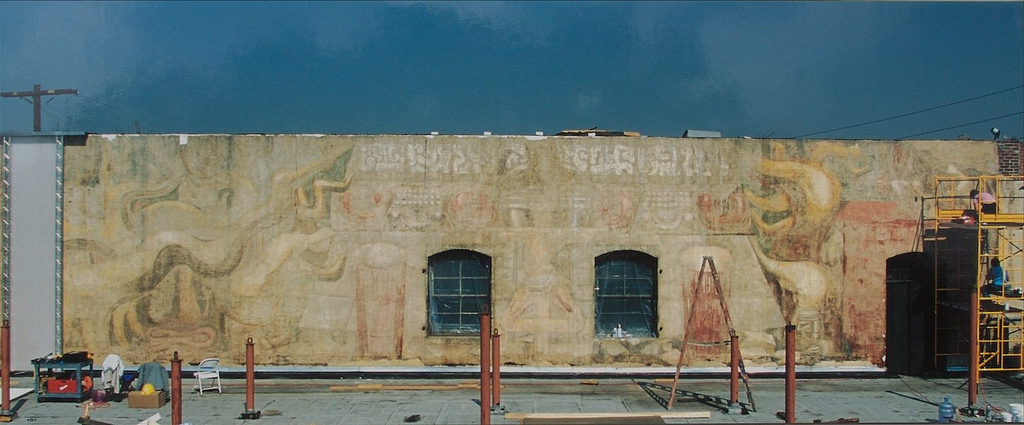
14. América Tropical (1932) — David Alfaro Siqueiros. An Indigenous figure crucified beneath the American eagle, painted on a Los Angeles wall facing Olvera Street. The city whitewashed it within the decade. Its slow re-emergence from under that whitewash is now part of the work: censorship, weathering into evidence.
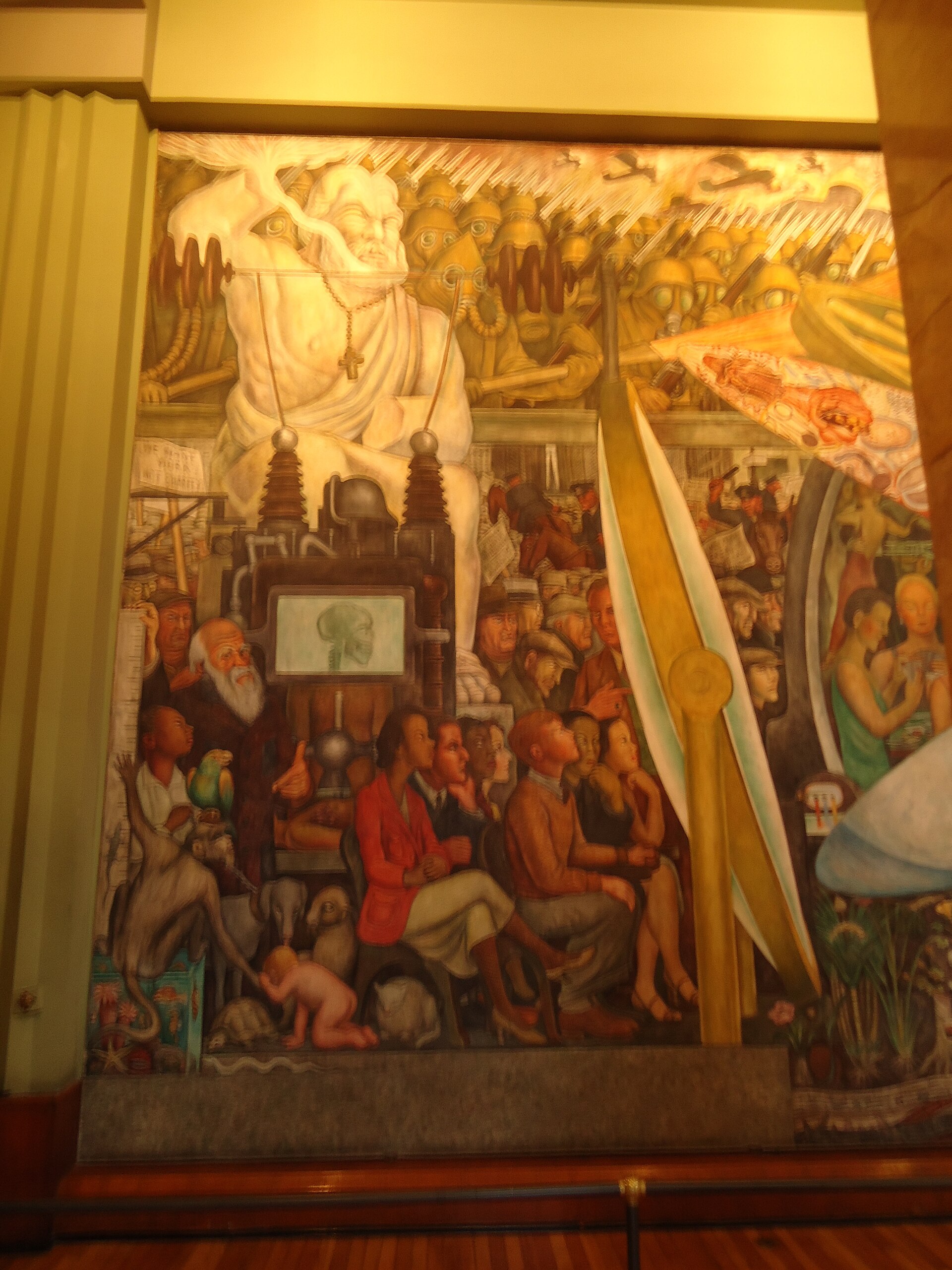
15. Man at the Crossroads (1933) — Diego Rivera. Commissioned for Rockefeller Center, destroyed by the Rockefellers when Rivera refused to remove Lenin’s portrait. The most famous mural of the century may be the one that no longer exists — proof that patronage and propaganda have never been cleanly separable.
16. Aspects of Negro Life (1934) — Aaron Douglas. Four panels, from Africa through slavery and Reconstruction to the modern city, painted for a Harlem library under the WPA. Douglas’s silhouetted geometry carried Black history into public architecture at the height of the Depression, insisting the story belonged on the wall.
17. Roar, China! (1935) — Li Hua. A bound, blindfolded man strains against his ropes in one of the great woodcuts of the century. Made as Japan pressed into China, Li’s image taught a generation of Chinese printmakers that a block of wood, cut in anger, could move like an army.
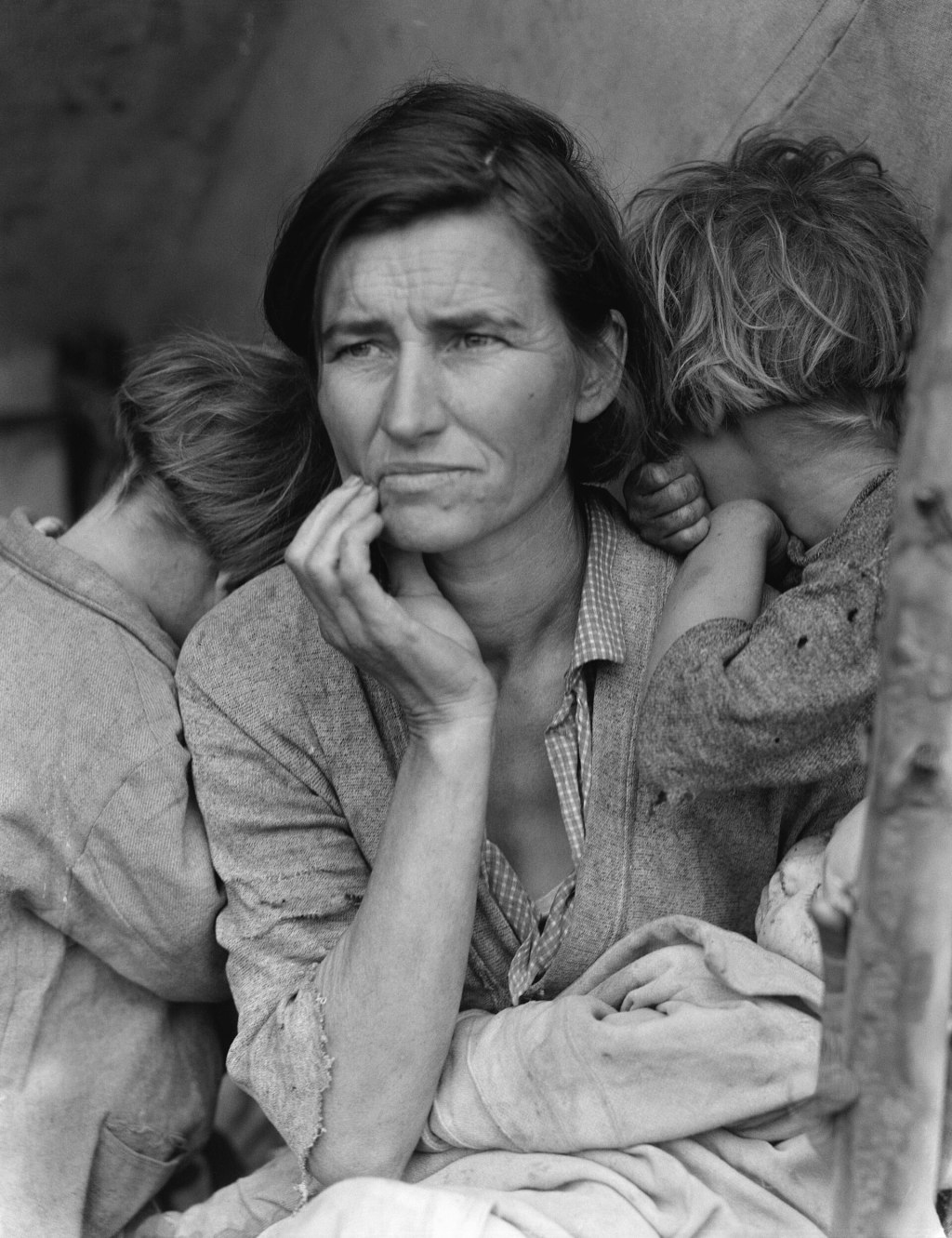
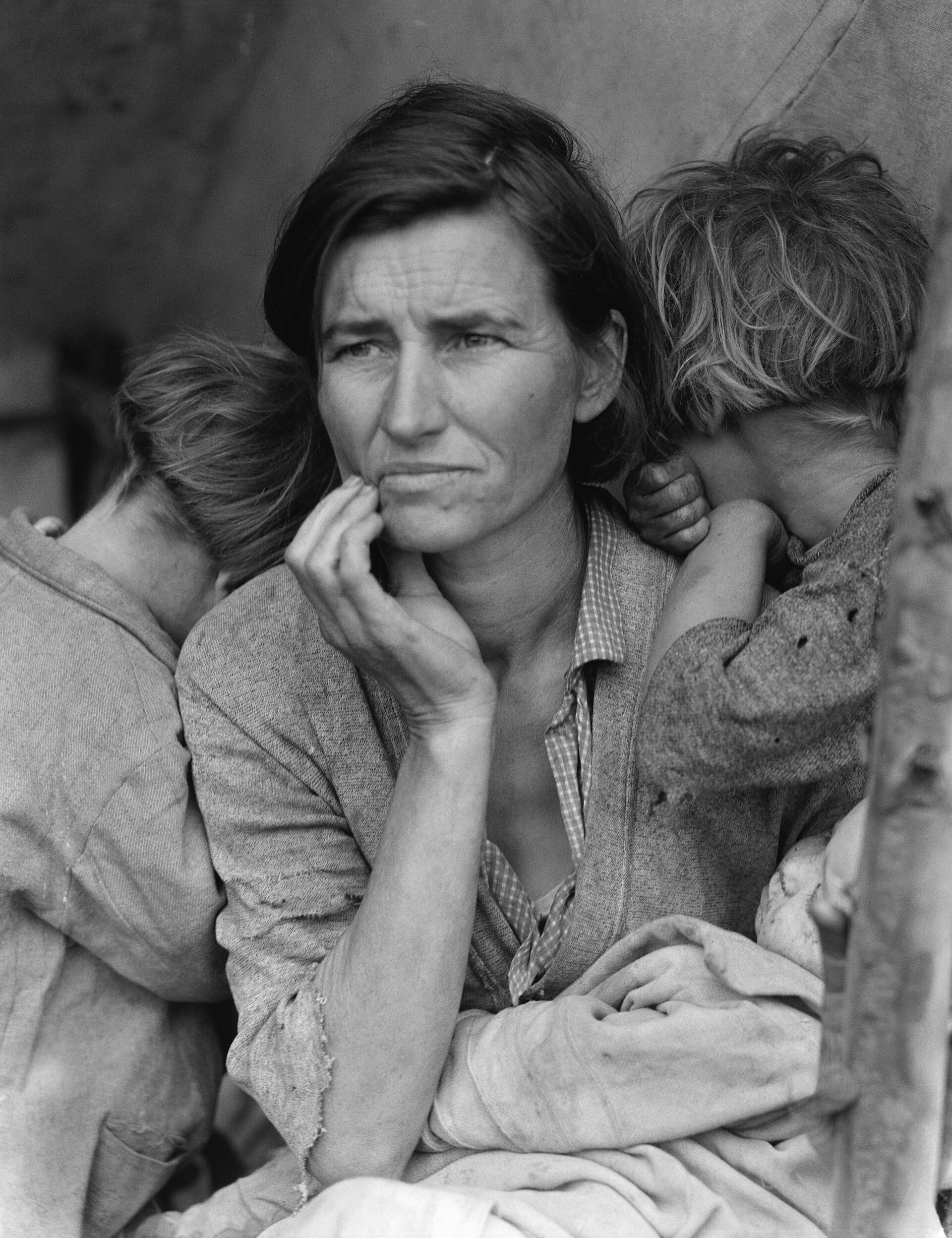
18. Migrant Mother (1936) — Dorothea Lange. Florence Owens Thompson, a destitute pea-picker’s widow, photographed for the Farm Security Administration in Nipomo, California. The image forced emergency food aid within days and then outgrew its assignment entirely — it is still the face the Depression wears.
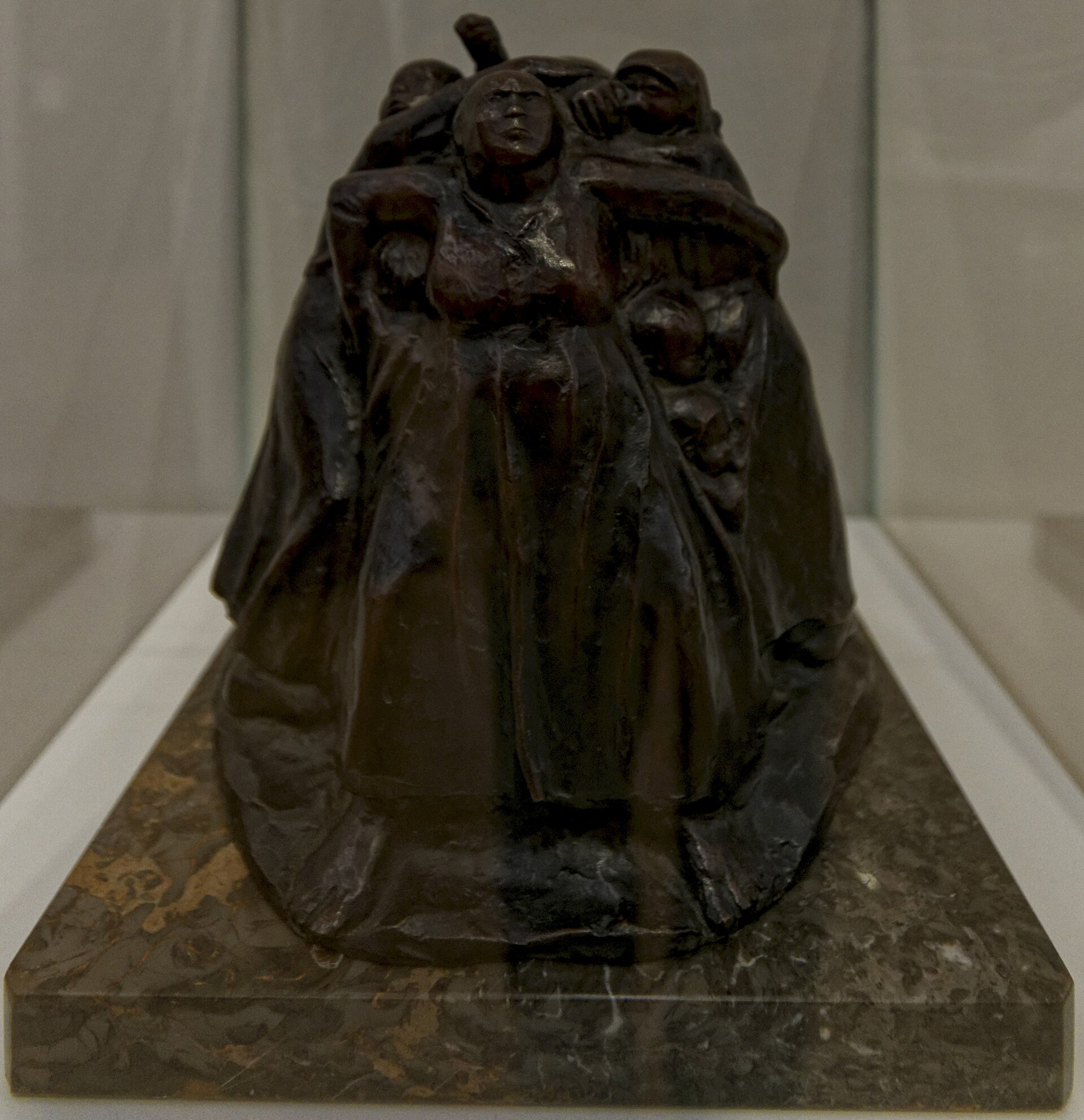
19. Tower of Mothers (1937–38) — Käthe Kollwitz. A bronze knot of mothers shielding their children with their own bodies, made by an artist who had lost a son in the First World War and was watching Germany arm for the second. The Nazis removed her work from view; the sculpture’s defense is purely physical — no weapons, just women in the way.
20. Guernica (1937) — Pablo Picasso. Painted in weeks after German bombers destroyed a Basque market town, and still the standard against which political painting is measured. Its refusal of heroes, villains in uniform, or even a visible airplane is the point: this is what war does to a room, a street, a species.
The 1940s
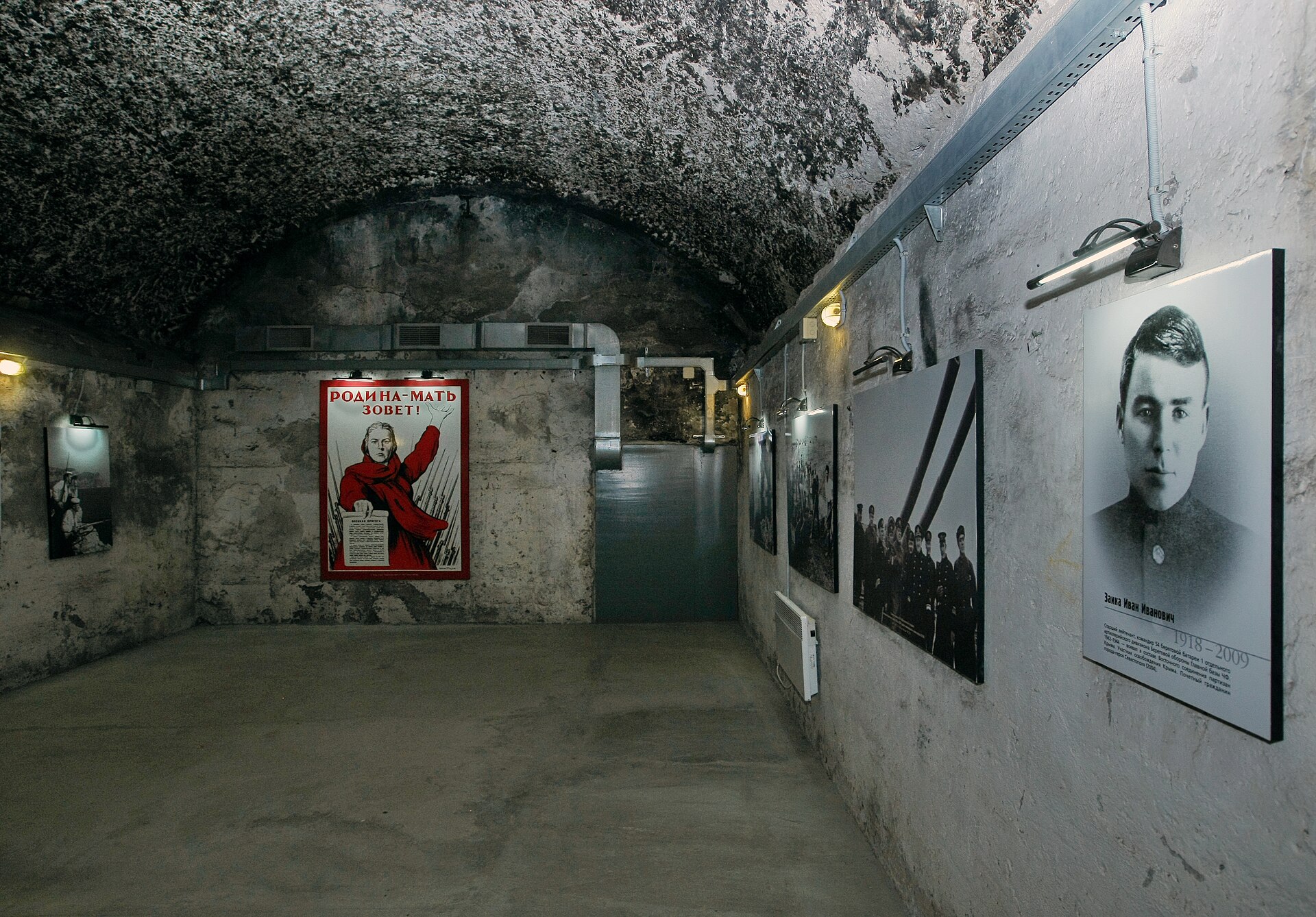
21. The Motherland Calls (1941) — Irakli Toidze. A woman in red raises one hand in oath and holds the military enlistment text in the other, bayonets at her back. Printed in millions within days of the Nazi invasion of the Soviet Union, it may be the most effective recruiting poster ever made.
22. The Migration Series (1940–41) — Jacob Lawrence. Sixty small panels, painted at age twenty-three, telling how Black Southerners remade America by leaving. Lawrence’s captions are as flat and factual as his shapes; the restraint is the rhetoric. No American epic of the century is told with less waste.
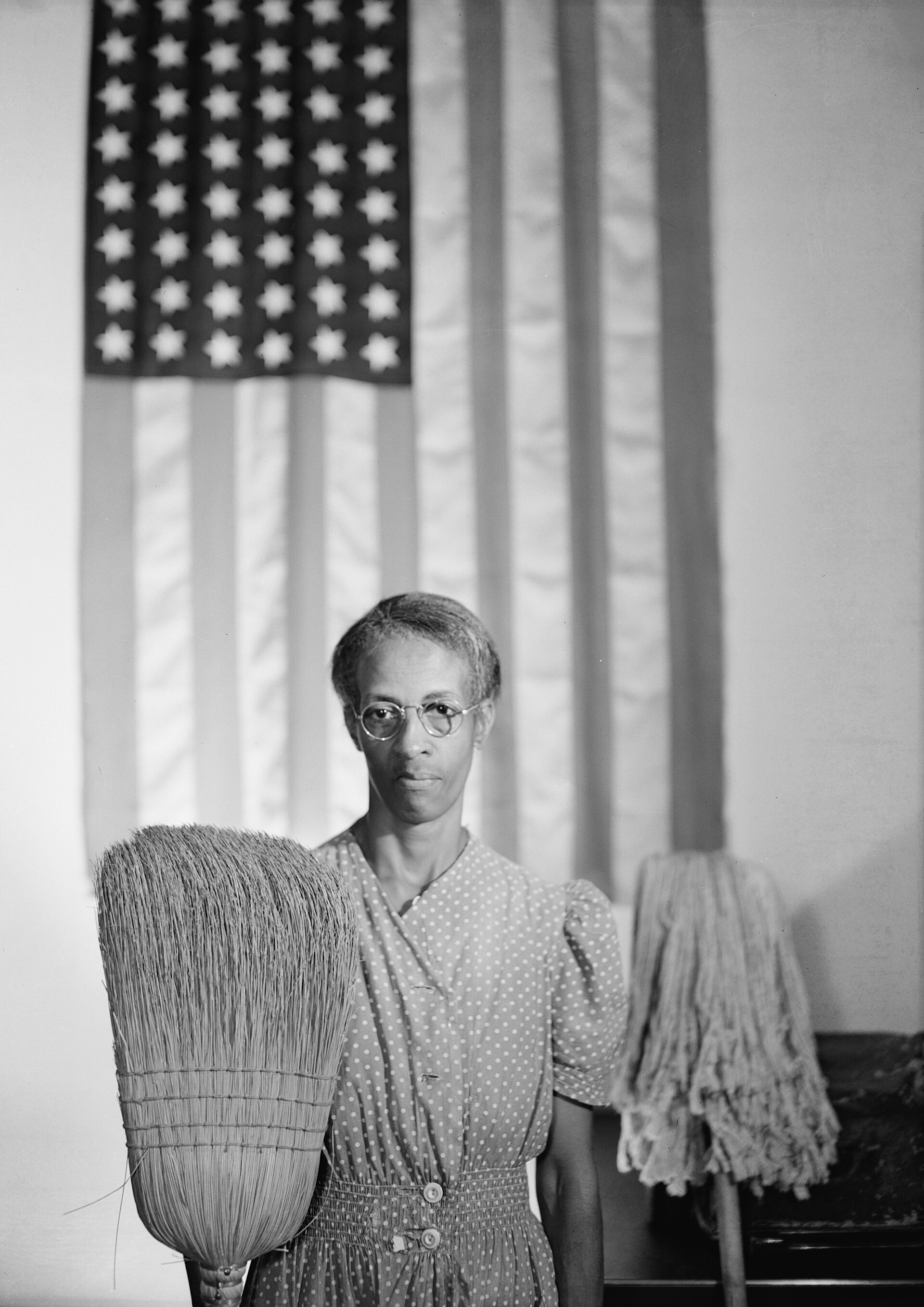
23. American Gothic (1942) — Gordon Parks. Ella Watson, a government cleaning woman, stands with mop and broom before an American flag, posed after Grant Wood. Parks, newly hired at the FSA, made the era’s most economical image of American racism: the flag, the worker, and the distance between them.
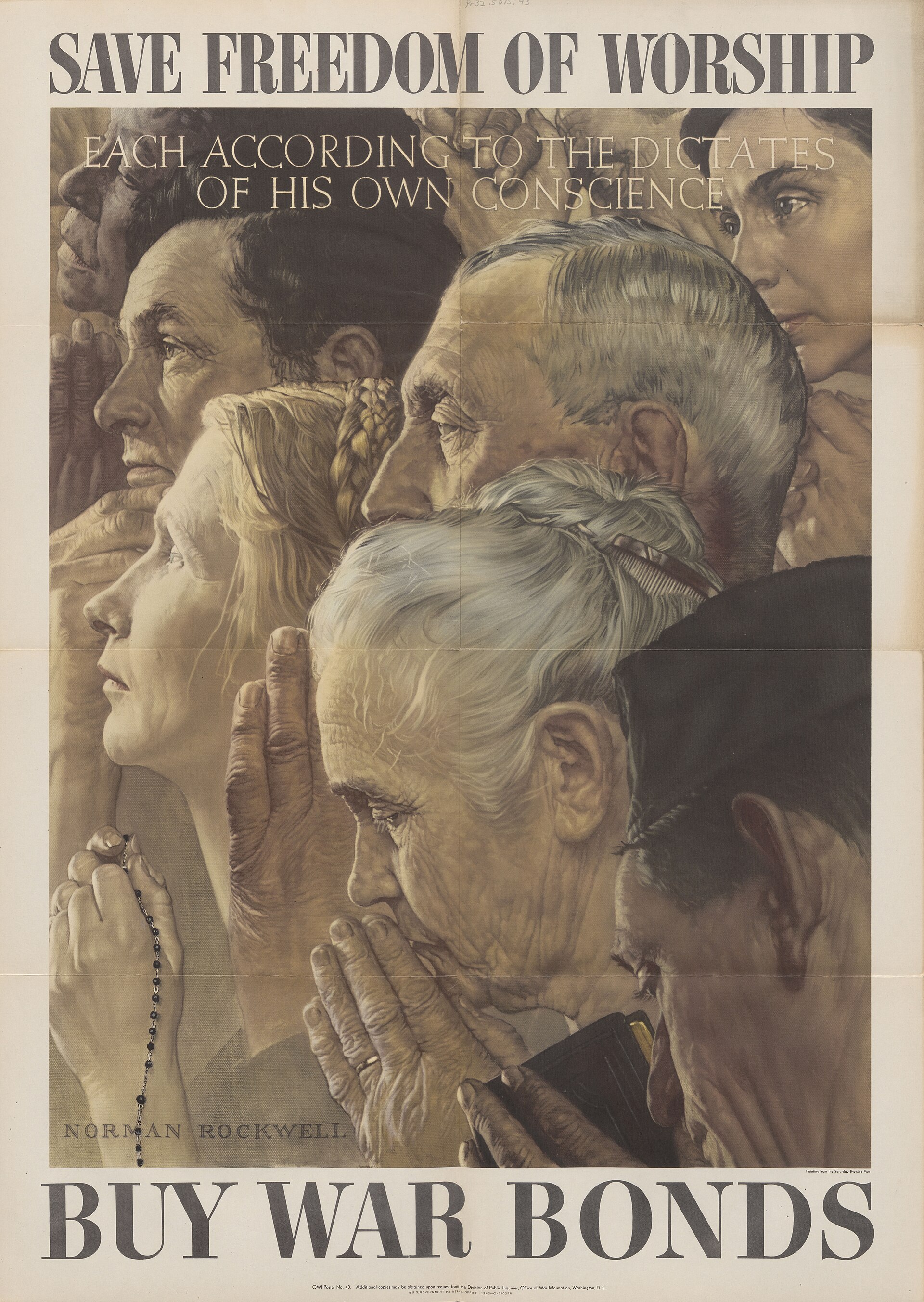
24. Four Freedoms (1943) — Norman Rockwell. Four magazine covers translating a presidential speech into scenes of ordinary American life. One can argue about Rockwell’s sentimentality; one cannot argue with the result — the series toured the country and raised over $130 million in war bonds. Illustration, at full power, is policy.
25. The Jungle (1943) — Wifredo Lam. Sugarcane, spirits, and bodies fuse into a single Afro-Cuban thicket, painted after Lam returned to a Cuba whose Black culture the state celebrated and policed at once. It hangs at MoMA as modernism; it reads, at home, as an assertion that the island’s African roots were the culture.
26. Famine Sketches (1943) — Zainul Abedin. Ink drawings of the starving made during the Bengal famine, which killed millions under British wartime policy. Abedin sketched what official India declined to photograph. The drawings’ speed is their truth — paper, ink, and no time for composition while people died in the street.
27. Os Retirantes (1944) — Candido Portinari. A family of drought refugees crosses a dead landscape, children already skeletal, vultures overhead. Brazil’s defining social painting: Portinari, himself a coffee-picker’s son, made the sertão’s misery impossible for the salon public to unsee.
28. The Liberation Photographs (1945) — Lee Miller. Miller entered Buchenwald and Dachau with the American forces in April 1945 and cabled her editors at Vogue to believe it — she had seen it. A fashion photographer turned war correspondent produced some of the Holocaust’s defining evidence, in a magazine her readers trusted, which is why it landed.
29. Citizen 13660 (1946) — Miné Okubo. Two hundred and six drawings of the Japanese American incarceration, made by a woman who lived it at Tanforan and Topaz — the first published account of the camps by an internee. Okubo’s deadpan line records barbed wire, latrines, and roll calls with the same even hand, which is the accusation.
30. Song of the Pick (1946–47) — Gerard Sekoto. Black workers swing picks under a white overseer’s gaze, painted in Johannesburg just before apartheid became law and Sekoto left for the exile he never returned from. The rhythm of the labor is the rhythm of the country being built — by these hands, for those eyes.
The 1950s
31. Ghosts, from The Hiroshima Panels (1950) — Iri and Toshi Maruki. The first of fifteen monumental panels painted across three decades: a procession of burned figures moving through darkness. The Marukis toured the panels to towns across Japan and then the world — the work’s real medium is the journey, carrying testimony where museums couldn’t.
32. Massacre in Korea (1951) — Pablo Picasso. A firing squad of armored, robotic soldiers levels its weapons at naked women and children. Painted during the Korean War and attacked from both sides of the Cold War divide, it is Picasso’s most direct anti-war statement after Guernica — and its discomfort was the point.
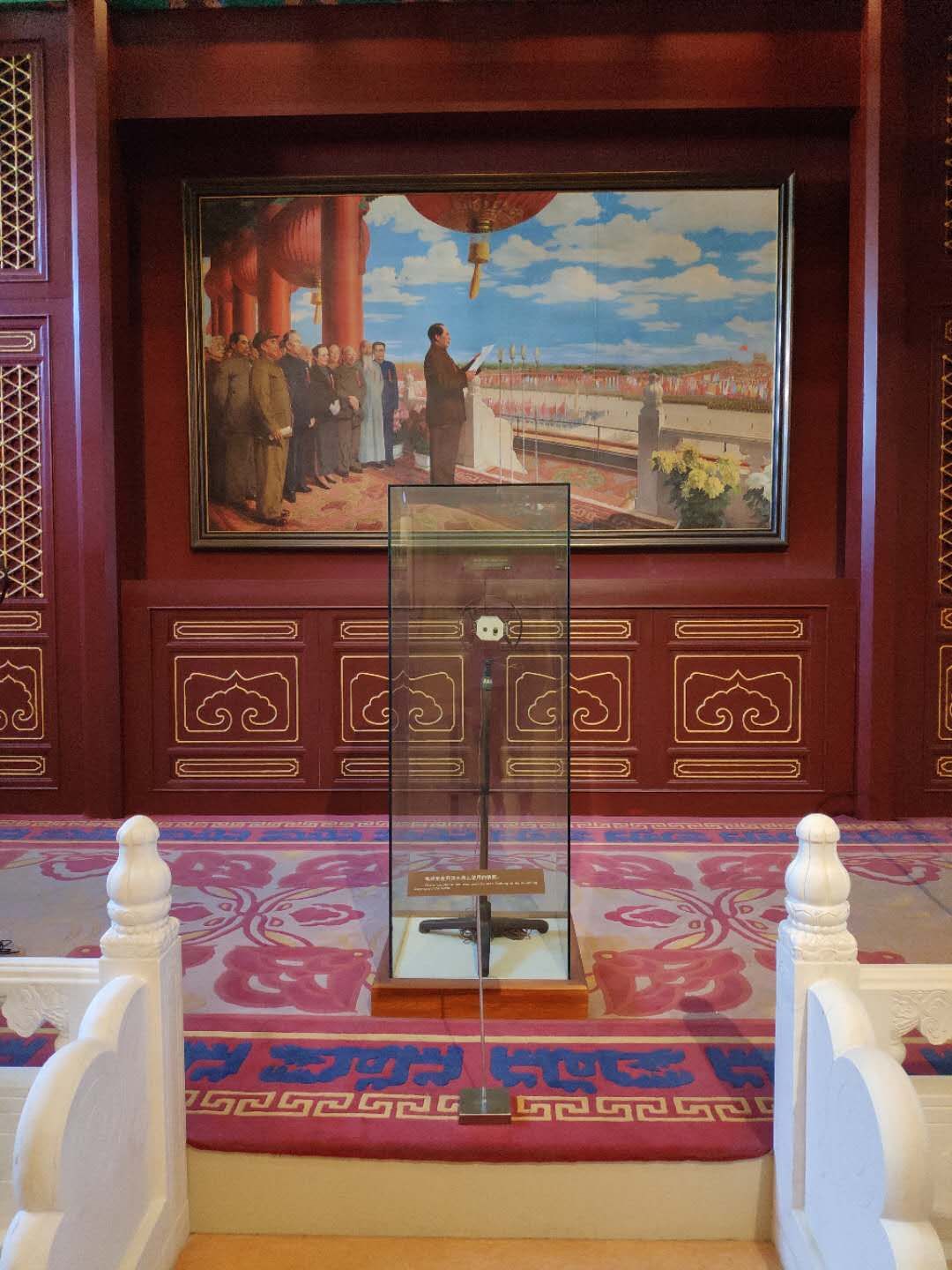
33. The Founding of the Nation (1953) — Dong Xiwen. The official image of Mao proclaiming the People’s Republic from Tiananmen in 1949, painted for the new state — then repainted, repeatedly, as leaders beside Mao were purged and had to be painted out. No artwork of the century documents how regimes edit memory more literally than this canvas, edited by its own government.
34. Where to..? (1953) — Ismail Shammout. Refugees walk out of Lydda into exile, painted five years after the 1948 death march the picture records, by an artist who walked it as a teenager. Shammout’s refugees are not symbols; they are neighbors. Palestinian art’s founding image is a question nobody has answered.
35. Marxism Will Give Health to the Sick (1954) — Frida Kahlo. Kahlo’s last painting: herself in a steel corset, sustained by the hands of Marx, casting away her crutches. Unfinished and unembarrassed, it is the century’s most literal self-portrait of political faith — ideology as the thing that lets a broken body stand.
36. The Struggle: From Slavery to Reconstruction (1954–56) — Jacob Lawrence. Thirty panels on American history commissioned by a magazine and scattered by its sale, only recently reunited. Lawrence had to fight for episodes the editors found uncomfortable — the series’ fragmented afterlife is itself a lesson in whose history gets kept whole.
37. The Family of Man (1955) — Edward Steichen. Five hundred and three photographs from sixty-eight countries, arranged at MoMA as a single human story of birth, work, and death. Two million visitors saw it on its world tour. Critics then and since have called it Cold War sentimentality that dissolves politics into feeling — and it belongs on this list precisely because that argument matters.
38. Zameen (1955) — M. F. Husain. “Land”: peasants bent across a partitioned earth, painted the decade India’s new republic was staking its future on land reform. Husain carried modernism out of the gallery and onto the street hoarding; Zameen is his claim that the peasant, not the minister, is the nation’s central figure.
39. Just What Is It That Makes Today’s Homes So Different, So Appealing? (1956) — Richard Hamilton. A bodybuilder, a pin-up, a television, a tinned ham: the founding collage of Pop, made from American magazine advertisements. Its politics are diagnostic — here, in a London show about tomorrow, is the consumer dream arriving fully assembled to govern postwar life.
40. The Americans (1958) — Robert Frank. Eighty-three photographs from a Guggenheim road trip: segregated buses, lonely flags, jukeboxes, funerals. Published first in Paris because no American house would touch it, Frank’s book remains the sharpest outsider’s audit of the country’s promises — taken at gas stations, not podiums.
The 1960s
41. Race Riot (1963) — Andy Warhol. Silkscreened police dogs lunging at a Black demonstrator, repeated until the news photograph becomes wallpaper. Warhol’s coldest series took its images from the press coverage of Birmingham and asked what repetition does to conscience — a question the feed era has answered daily since.
42. The Birmingham Photographs (1963) — Charles Moore. Dogs and fire hoses turned on young civil rights marchers, printed in Life and seen around the world. Moore’s pictures are routinely credited with shifting Northern opinion behind the Civil Rights Act — photojournalism as legislation’s advance guard.
43. F-111 (1964–65) — James Rosenquist. An eighty-six-foot painting that wraps the viewer in a fighter-bomber interleaved with spaghetti, tires, and a child under a hair dryer. Rosenquist, an ex-billboard painter, sold the military-industrial complex back to America in its own advertising format: everything for sale, including the war.
44. Western and Christian Civilization (1965) — León Ferrari. A figure of Christ crucified on an American fighter jet, made as U.S. bombing of Vietnam escalated. The Argentine artist stated his program plainly — art as efficacy and agitation — and this sculpture remains its purest object: one image, no footnotes, instant verdict.
45. House of Bondage (1967) — Ernest Cole. A Black South African photographer’s hidden-camera record of apartheid’s daily machinery — pass raids, mine compounds, segregated everything — smuggled out and published in New York. The book was banned at home; Cole died in exile. Few photobooks have cost their maker more, or shown more.
46. Die (American People Series #20) (1967) — Faith Ringgold. Bodies of every race fall together across a blood-spattered field, in the summer of America’s urban uprisings. Ringgold painted what television showed nightly and the museums wouldn’t hang: the riot not as backdrop but as the national portrait.
47. Graphics for The Black Panther newspaper (1967– ) — Emory Douglas. As the paper’s art director and the Panthers’ Minister of Culture, Douglas built a visual language — bold woodcut lines, the pig as police, Black families armed with dignity — that any reader could redraw. The newspaper reached hundreds of thousands; the style reached further, and it still circulates.
48. House Beautiful: Bringing the War Home (1967–72) — Martha Rosler. Photomontages splicing Vietnam combat photographs into glossy American interiors: a soldier patrols a split-level living room. Rosler distributed them through the anti-war press, refusing the gallery. The series’ argument — that the war was furnished, carpeted, and consumed at home — has never expired.
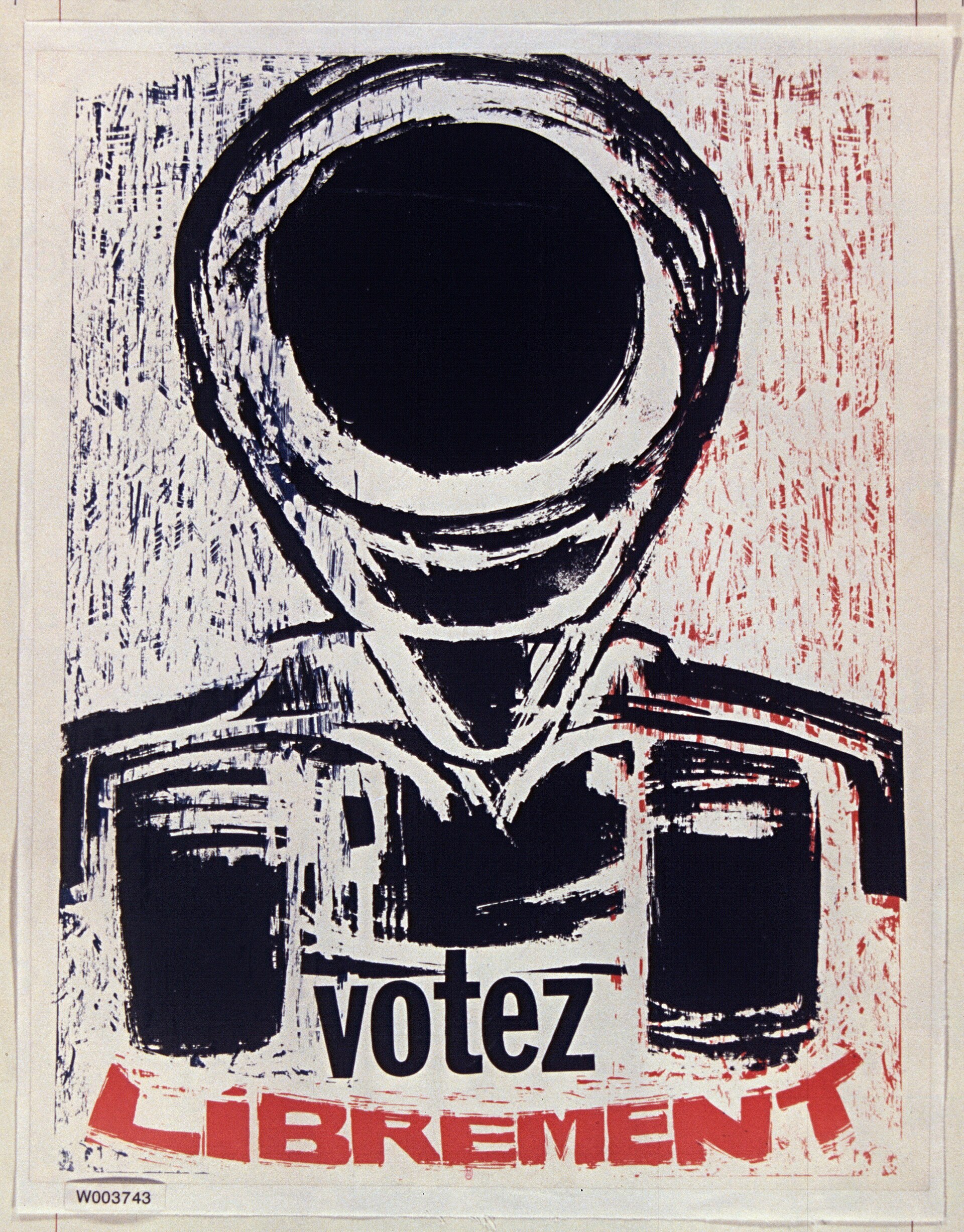
49. May ’68 posters (1968) — Atelier Populaire. Art students occupying the École des Beaux-Arts print workshop produced hundreds of anonymous silkscreen designs for the barricades, under one rule: the work belonged to the struggle, not to signatures or sales. The posters’ afterlife in the art market is the century’s tidiest irony about protest and property.
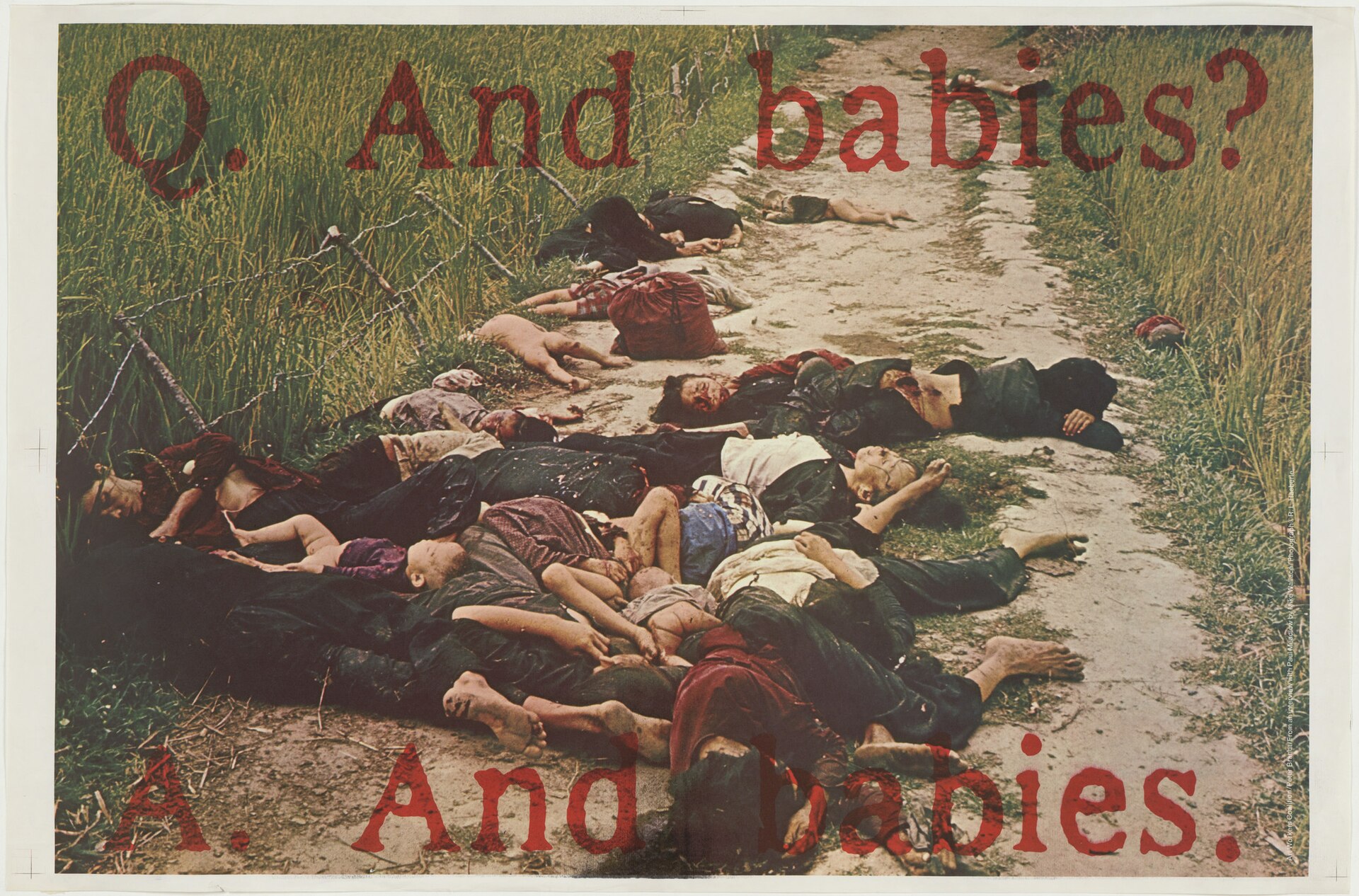
50. “And Babies?” (1969) — Art Workers’ Coalition. Fifty thousand posters, distributed free: a photograph of the My Lai massacre paired with words from a televised interview with a soldier who took part. When MoMA’s board — Rockefellers among them — blocked the museum’s sponsorship, the artists printed it themselves. The institutional refusal is now part of the work’s meaning.
The 1970s
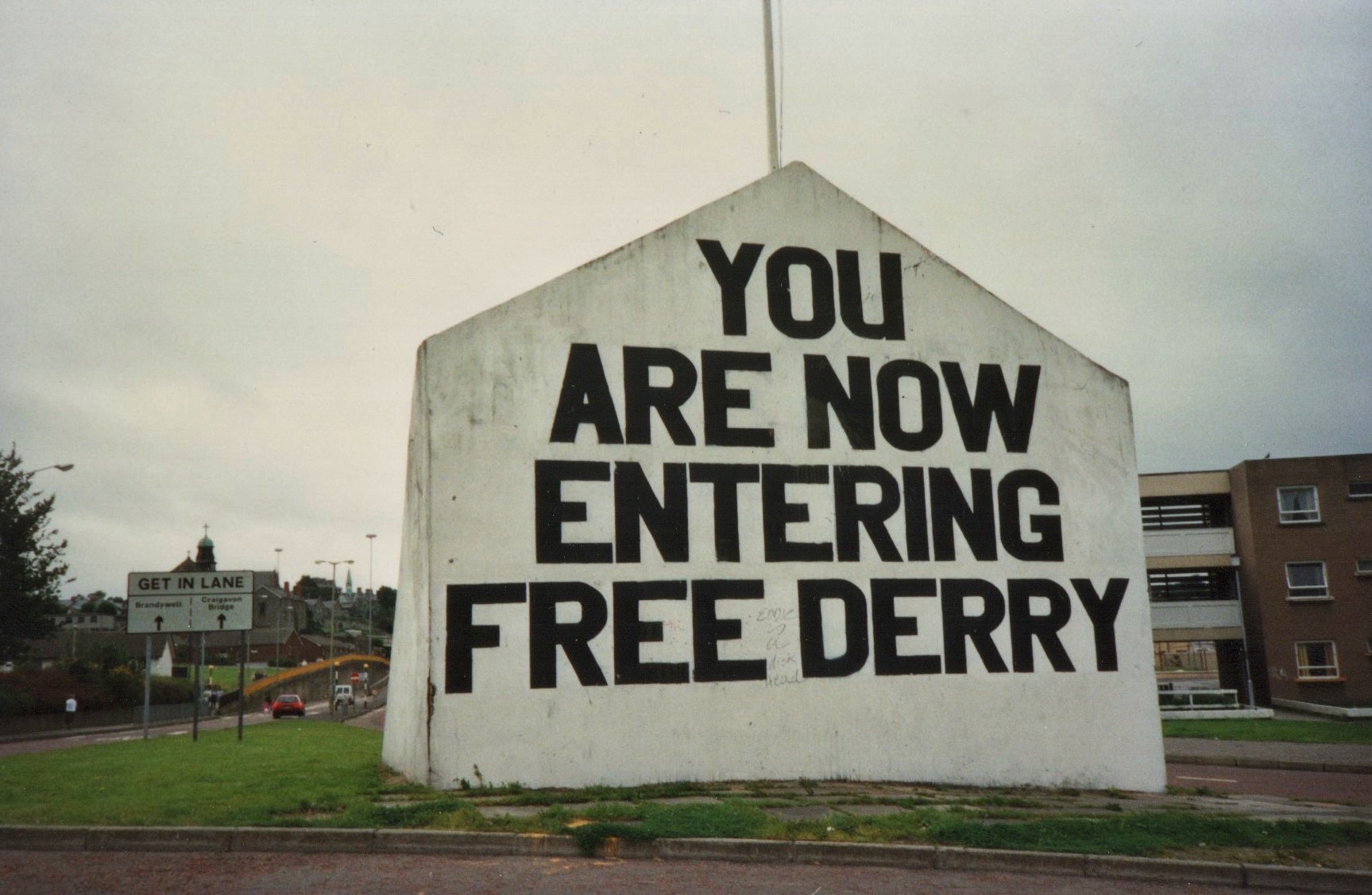
51. The Murals of the Troubles (1969– ) — the wall painters of Northern Ireland. In January 1969, on a gable end in Derry’s Bogside, someone painted five words — “You are now entering Free Derry” — and the North’s walls became its newspapers. Loyalist districts had painted King William at the Boyne since 1908; through the Troubles, republican Belfast and Derry answered with hunger strikers, martyrs, and solidarity panels for Palestine and the Basque Country, while loyalist walls replied with paramilitary gunmen and the Somme’s dead. Thousands of murals marked territory, memory, and warning, repainted as the war moved. The peace process has softened many into heritage, and tour buses now idle where checkpoints stood — but the walls still argue, which was always their function: a people’s history, written where the official record wouldn’t.
52. MoMA Poll (1970) — Hans Haacke. Museum visitors voted by ballot box on a pointed question: whether Governor Rockefeller’s silence on the Indochina war would cost him their vote — Rockefeller being, among other things, a MoMA trustee. The count ran heavily against him. Haacke simply moved the machinery of opinion-polling inside the temple and let the institution indict itself.
53. Injustice Case (1970) — David Hammons. A body print of the artist, framed by an American flag, answering the spectacle of Black Panther Bobby Seale bound and gagged in a Chicago courtroom. Hammons made the body’s impression — grease and pigment, a literal contact print of a person — stand for everyone the courtroom refused to hear.
54. The Crucifixion of Charlemagne Péralte for Freedom (1970) — Philomé Obin. In 1919, U.S. Marines ambushed Péralte, leader of Haiti’s Caco resistance to the American occupation; they strapped his body to a door, photographed it, and distributed the picture across Haiti as a warning. Half a century later, Obin — the defining painter of Haiti’s Cap-Haïtien school — took the occupier’s trophy photograph and reframed it as a crucifixion: the “bandit” of the Marine reports hangs as Christ, and the staged humiliation becomes martyrdom. It is the same image, answered. Haitian painting’s founding political act is this refusal to let the enemy’s camera have the last word.
55. Insertions into Ideological Circuits: Coca-Cola Project (1970) — Cildo Meireles. Under Brazil’s military dictatorship, Meireles silk-screened messages onto returnable Coca-Cola bottles in white lettering invisible against the empty glass and legible only once the bottle was refilled — “Yankees Go Home,” and, in later printings, instructions for turning the bottle itself into a Molotov cocktail. He then returned the bottles to the deposit system, so the corporation distributed his dissent for him, at national scale, to readers who never entered a gallery. Censorship-proof because it was indistinguishable from commerce, it remains the century’s most elegant hack of a distribution network: protest riding the enemy’s trucks.
56. Shoot (1971) — Chris Burden. In a Santa Ana gallery, a friend shot Burden in the arm with a rifle, as planned, barely. Fifteen seconds of film became the Vietnam era’s most argued-about performance: a controlled wound, voluntarily taken, in a country drafting young men for uncontrolled ones.
57. The Liberation of Aunt Jemima (1972) — Betye Saar. The pancake-box mammy, reassembled in a shadow box with a rifle and a raised, grenade-holding fist. Saar took American advertising’s most servile Black stereotype and rearmed her — the founding gesture of a career spent turning racist kitsch into ordnance.
58. Silueta Series (1973–80) — Ana Mendieta. The artist’s silhouette laid into earth, sand, fire, and flowers across Iowa and Mexico — made by a woman exiled from Cuba as a child. The works read now as a landmark of feminist and land art; they also record a diaspora’s question: where does a body belong, if not in this ground?
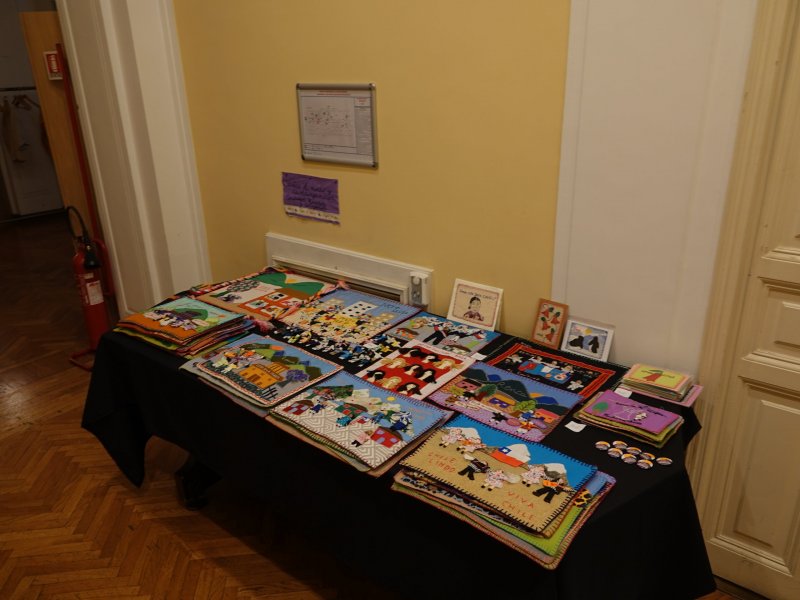
59. Arpilleras (1974– ) — women of Chile. Under the Pinochet dictatorship, mothers and wives of the detained and disappeared stitched appliqué scenes on burlap — raids, soup kitchens, missing faces — smuggled abroad through church networks for sale and testimony. Needlework the regime dismissed as women’s craft carried evidence its censors missed. The medium was the disguise.
60. Paki Bastard (Portrait of the Artist as a Black Person) (1977) — Rasheed Araeen. A Karachi-born artist in London turns the street slur thrown at South Asians into a self-portrait of defiance, made as racist violence rose in Britain. Araeen’s work demanded that British art reckon with the empire’s subjects arriving home — and with who counted as a British artist at all.
61. Revolution posters (1978–79) — artists and collectives of Iran. In the months that toppled the Shah, Tehran’s walls filled with posters fusing Shi’a martyrdom imagery, raised fists, and modernist design — many produced by art students working collectively and anonymously. They are the revolution’s first draft, printed before its outcome was known, and unlike much of what followed, they belong to everyone who pasted them up.
62. The Dinner Party (1974–79) — Judy Chicago. Thirty-nine place settings for women of history and myth, with 999 more names inscribed on the floor beneath — a banquet built to correct a record that had left women off the guest list entirely. Dismissed by the establishment for a generation, it now holds a permanent room in Brooklyn. The correction stuck.
63. Touch Sanitation (1979–80) — Mierle Laderman Ukeles. Over eleven months, Ukeles shook the hand of every one of New York’s 8,500-plus sanitation workers, thanking each for keeping the city alive. Maintenance — the labor that politics makes invisible — performed as a monumental portrait of a workforce, one handshake at a time.
The 1980s
64. Haywain with Cruise Missiles (1980) — Peter Kennard. Constable’s beloved pastoral hay cart, photomontaged to carry three nuclear cruise missiles into the English countryside. Made as American missiles arrived at Greenham Common, Kennard’s image did the peace movement’s whole argument in one glance: this landscape, those weapons, choose.
65. Interrogations II (1981) — Leon Golub. Mercenaries torture a hooded prisoner, painted at billboard scale in raw, scraped pigment. Golub sourced his scenes from photographs of the era’s proxy wars and Latin American death squads, then enlarged them past comfort. The painting’s ugliness is documentary: this is what the policy looked like up close.
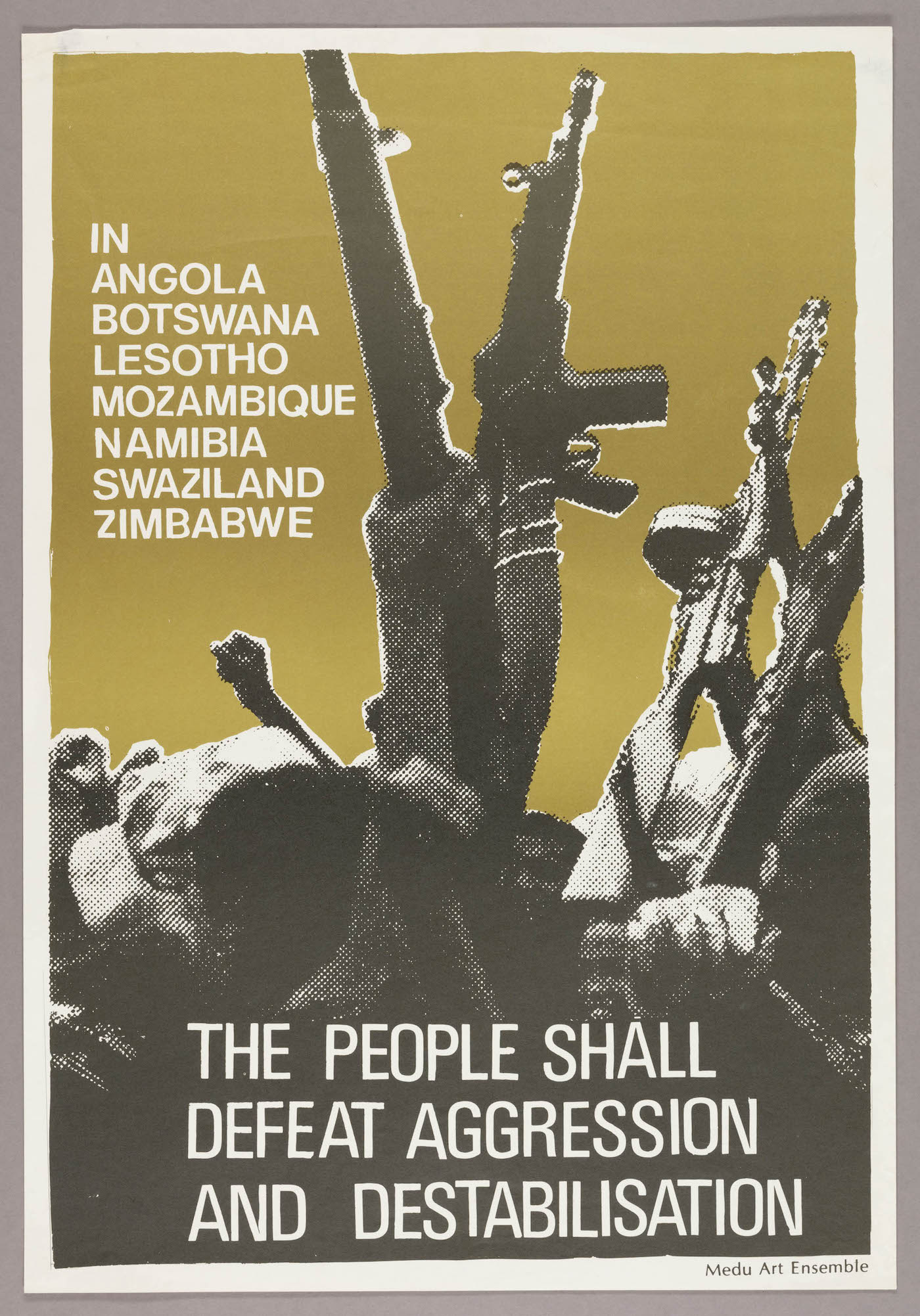
66. You Have Struck a Rock (1981) — Medu Art Ensemble. The exiled South African collective’s silkscreen posters — printed in Botswana, smuggled home, torn down by police, reprinted — took their titles from the rallying language of South African women’s resistance: strike a woman, strike a rock. Medu called culture a weapon of struggle and operated accordingly, until a South African cross-border raid killed its members in 1985.
67. Wheatfield — A Confrontation (1982) — Agnes Denes. Two acres of golden wheat, planted, tended, and harvested by hand on a rubble landfill in lower Manhattan, two blocks from Wall Street, on land valued at $4.5 billion. Denes built the work as an accounting of misplaced priorities — food, energy, and world hunger set against finance’s most expensive dirt. The harvest, over a thousand pounds of healthy wheat, went on to tour twenty-eight cities in an exhibition for the end of world hunger, its seeds planted around the globe. Environmental art’s founding gesture is a ledger entry: what the land could feed, measured against what the market said the land was for.
68. Defacement (The Death of Michael Stewart) (1983) — Jean-Michel Basquiat. Painted on a studio wall after the young graffiti artist Michael Stewart died in police custody following an arrest for writing on a subway wall. Basquiat, who had written on the same walls, asked who the real vandals were. It is his most direct work — grief and identification, not mythology.
69. How to Commit Suicide in South Africa (1983) — Sue Coe, with Holly Metz. A visual exposé of apartheid built from the regime’s own euphemism — detainees who officially “committed suicide” in custody, beginning with Steve Biko. Coe’s drawings and the documented record, bound together, became a divestment organizing tool on American campuses. Art as an affidavit.
70. The Inevitable (1984–85) — Ibrahim El-Salahi. A nine-panel ink panorama conceived a decade earlier in a Sudanese prison cell, where El-Salahi — a senior culture official jailed without trial on fabricated charges under the Nimeiri regime — drew his ideas in the sand with a sharpened toothbrush and erased them before the guards came. Painted at last in exile, its fused calligraphy and swarming bodies carry the message he stated plainly: people ground down long enough will rise; that rising is the inevitable. He has said the work belongs to the Sudanese people, and that he will bring it home when their rights are restored. It is still waiting. Sudanese modernism’s central picture is a promise made in a cell.
71. The Gwangju Woodcuts (1980– ) — Hong Song-dam. When South Korean paratroopers sealed off Gwangju in May 1980 and massacred the citizens who had risen against the military coup, the city’s own artists became its wire service. Hong, who had been in the streets, cut the uprising into woodblocks — images that could be printed cheaply, carried past the cordon, and posted where the censored press would not go. The state answered the medium nine years later: arrested under the National Security Act for sending a slide of a collaborative liberation-history mural to a youth festival in Pyongyang, he was imprisoned and adopted by Amnesty International as a prisoner of conscience. The woodcuts remain the democracy movement’s first draft of its own history, printed in anger while the official one was still being lied about.
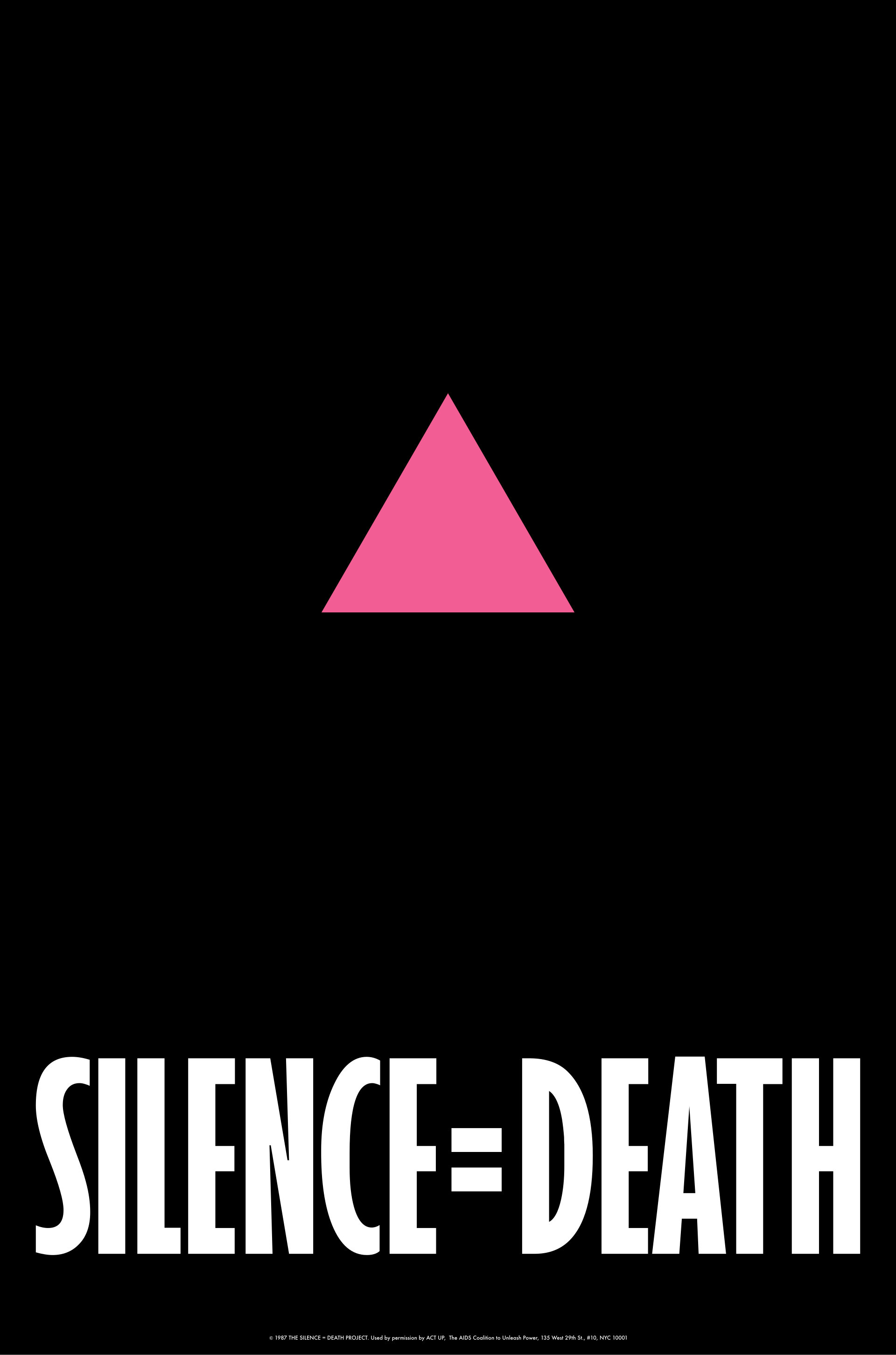
72. Silence = Death (1987) — Silence=Death Project / ACT UP. A pink triangle — the badge the Nazis forced on gay prisoners, reclaimed and pointed upward — over a single equation. Wheatpasted across New York as the government let AIDS burn, the poster named the policy precisely: silence was not neglect, it was the mechanism.
73. A Logo for America (1987) — Alfredo Jaar. A Times Square billboard animation: a map of the United States, captioned “This Is Not America”; the hemisphere, captioned “America.” The Chilean artist used advertising’s own forty seconds to correct a continent’s stolen name, in the middle of the Reagan-era interventions in Central America. It has only dated in one respect — it is needed again.
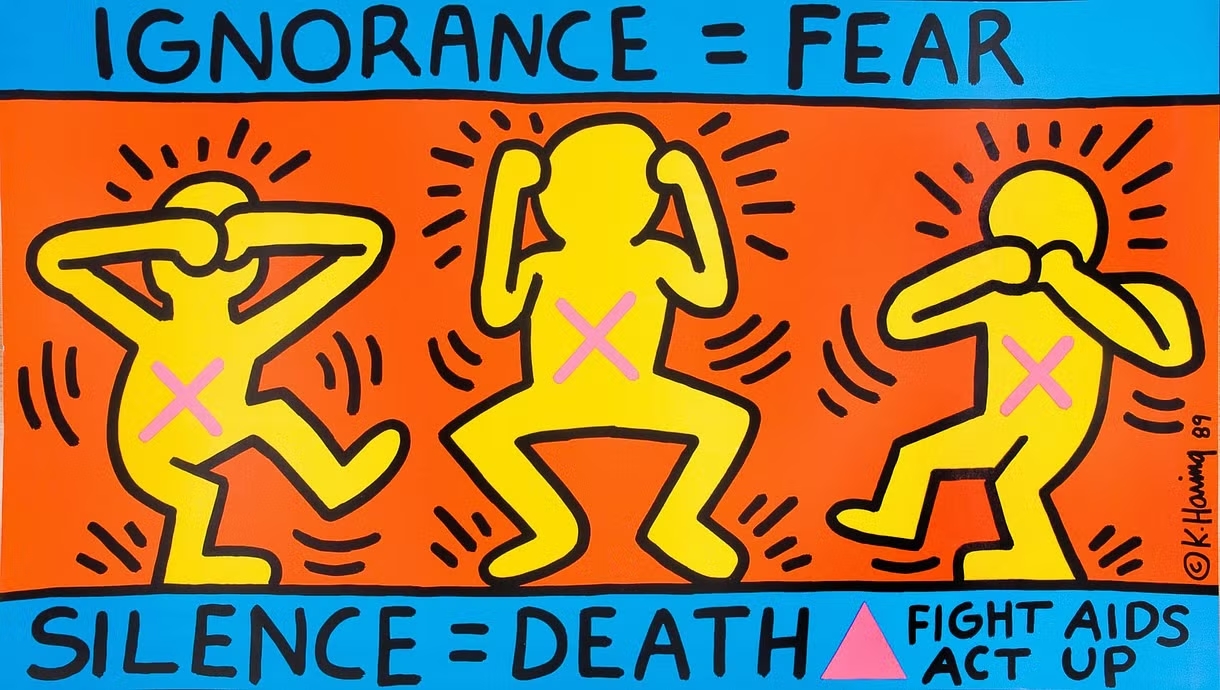
74. Ignorance = Fear (1989) — Keith Haring. Haring’s last great poster campaign for ACT UP: three figures covering eyes, ears, and mouth while the epidemic’s real accelerant — willful ignorance — is named in block letters. He was himself two years from diagnosis, one year from death. The poster is a dying man spending his remaining fame on other people’s survival.
75. Your Body Is a Battleground (1989) — Barbara Kruger. Produced for the 1989 march on Washington for women’s reproductive rights: a woman’s face split into photographic positive and negative, text laid over it like a news banner. Kruger built the image to be carried, and it was — and it has been carried at marches ever since, because the battleground never moved.
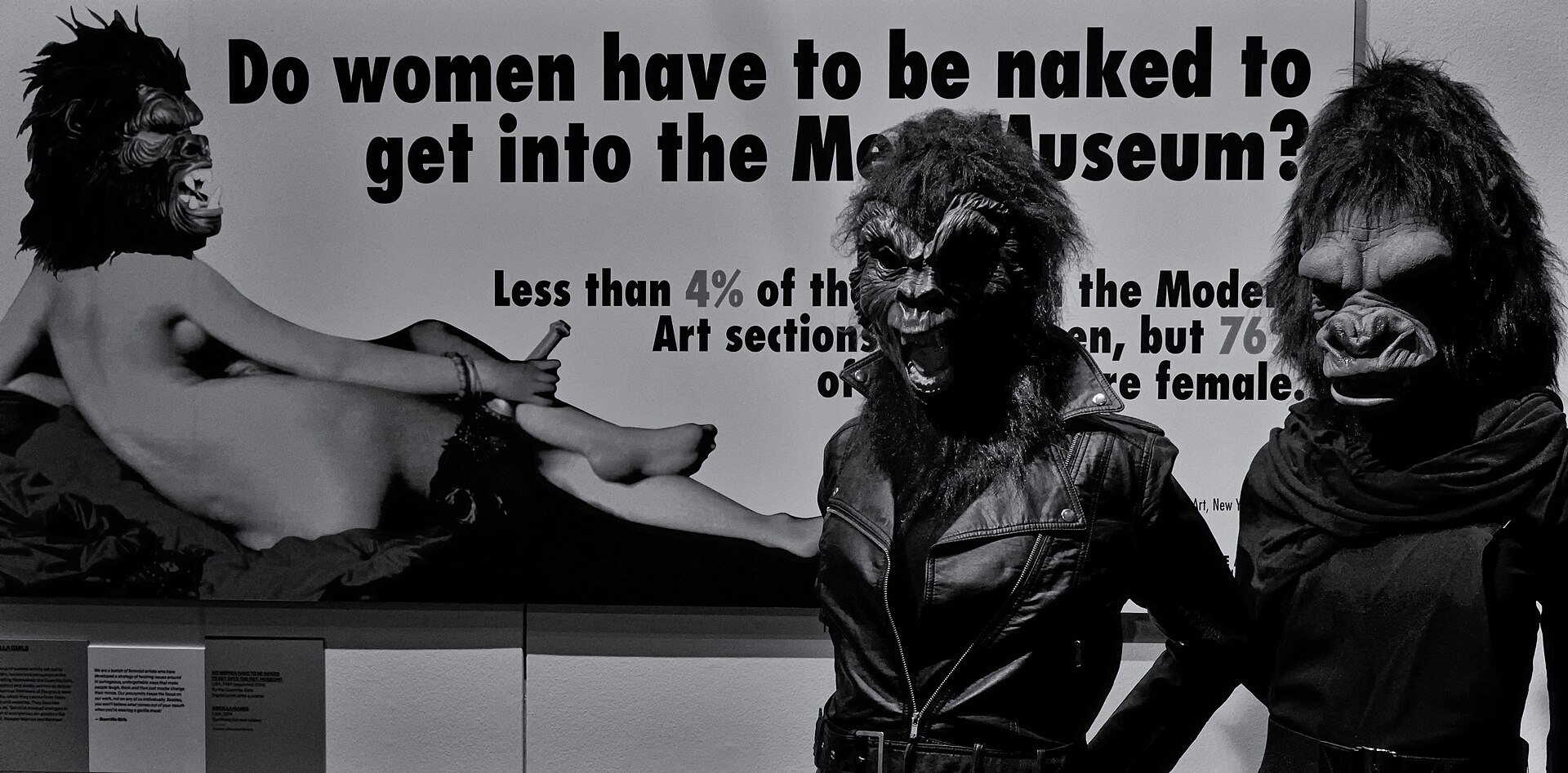
76. Do Women Have to Be Naked to Get into the Met. Museum? (1989) — Guerrilla Girls. The anonymous collective’s billboard arithmetic: under 5 percent of the artists in the Met’s modern sections were women, while 85 percent of the nudes were female. A statistic, a gorilla mask, and a borrowed Ingres odalisque — the work did what decades of polite complaint had not, and the Met has been answering for its numbers since.
The 1990s
77. Untitled (One Day This Kid…) (1990) — David Wojnarowicz. A childhood photograph of the artist ringed with text predicting, in cold future tense, what a homophobic country will do to this kid when it finds out he desires men. Written as AIDS took his friends and then him, it converts autobiography into indictment — the most quietly furious page of the culture-war years.
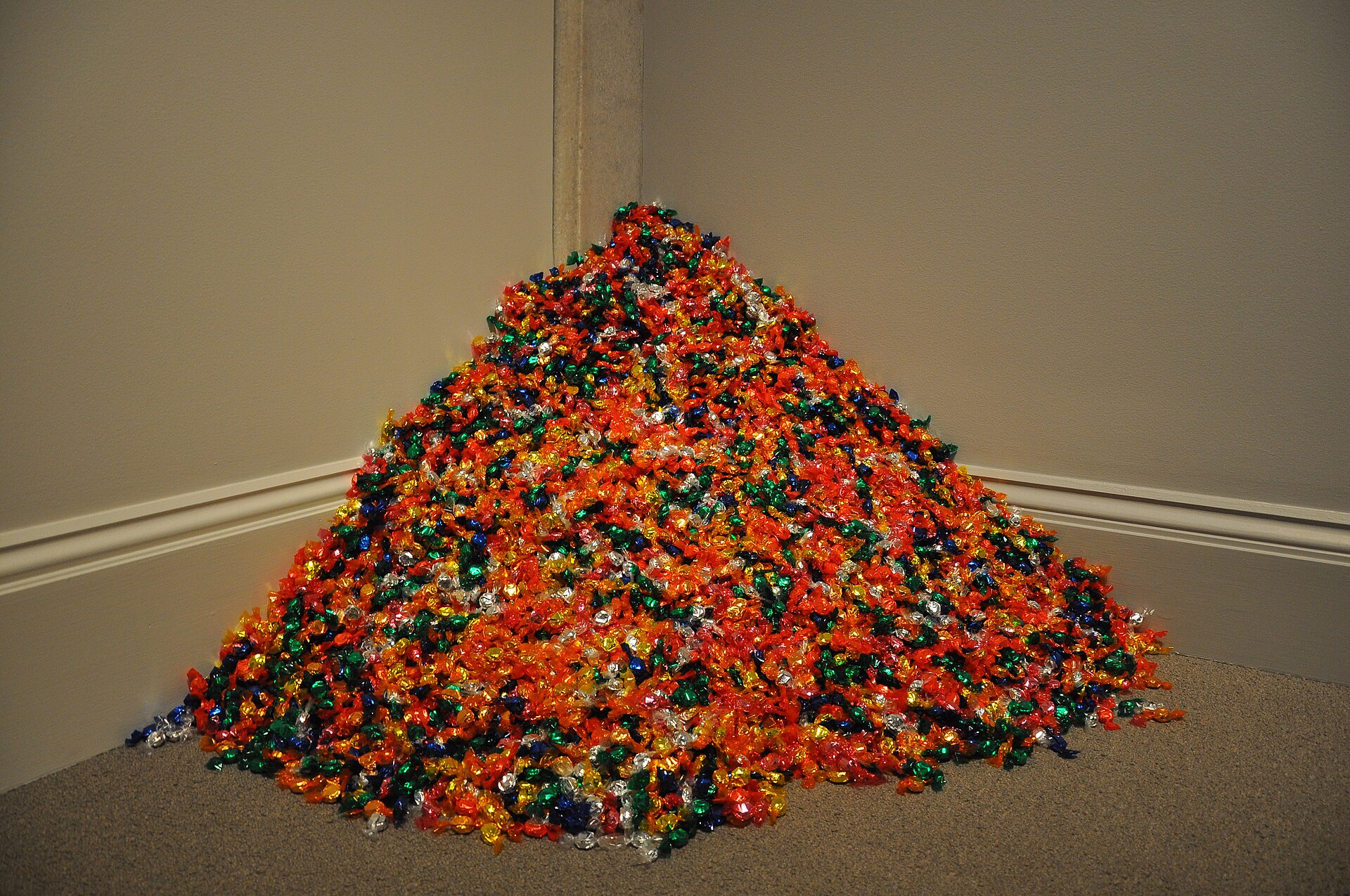
78. Untitled (Portrait of Ross in L.A.) (1991) — Felix Gonzalez-Torres. A pile of wrapped candies weighing 175 pounds — the ideal body weight of the artist’s partner, Ross, who died of AIDS that year. Visitors take a piece; the pile dwindles; the museum replenishes it. A portrait, a memorial, and an argument about generosity in the face of loss, conducted without a single image of a body.
79. Great Criticism — Coca-Cola (1991) — Wang Guangyi. Cultural Revolution heroes — worker, peasant, soldier — stride forward in propaganda formation, brandishing an oversized pen at a Coca-Cola logo. The signature canvas of China’s Political Pop: two totalizing systems, the campaign and the market, caught in one frame at the moment the second began eating the first.
80. Women of Allah (1993–97) — Shirin Neshat. Portraits of veiled Iranian women, many bearing arms, their skin inscribed with Farsi poetry by women writers. Made by an artist who left Iran before the revolution and returned to a country she no longer recognized, the series refuses both the regime’s script and the Western one — its women are armed, literate, and unreadable on purpose.
81. Gone (1994) — Kara Walker. A wall of black cut-paper silhouettes staging an antebellum romance of violence, desire, and power, installed at MoMA when Walker was twenty-four. The work uses a genteel parlor craft to depict what genteel history left out, and the fights it started — over who may picture slavery, and how — are part of its permanent record.
82. Corps étranger (1994) — Mona Hatoum. The artist turns an endoscopic camera on and through her own body, the footage projected inside a cylindrical chamber the viewer leans into. A Palestinian artist raised in exile in Beirut and London made the foreign body literal: the most intimate territory is the one no border regime can issue papers for.
83. Felix in Exile (1994) — William Kentridge. Charcoal drawings erased and redrawn into film as South Africa crossed from apartheid to democracy: Felix dreams in a hotel room while the landscape outside absorbs the era’s dead. Kentridge’s smudged, self-erasing medium is the argument — memory in the new country would be a palimpsest, not a clean page.
84. Dropping a Han Dynasty Urn (1995) — Ai Weiwei. Three photographs: the artist holds a two-thousand-year-old ceremonial urn, lets it fall, stands among the shards. Made in a China demolishing its past to build the future, the gesture asks what a heritage is worth, who may spend it, and what kind of iconoclasm the state itself practices daily at far larger scale.
85. The Holy Virgin Mary (1996) — Chris Ofili. A Black Madonna in Ofili’s signature materials — resin, glitter, map pins, and elephant dung — shown at the Brooklyn Museum in 1999, where New York’s mayor tried to shut the exhibition down over it. The work itself is devotional; the scandal around it exposed how quickly blasphemy charges are reached for when the Madonna isn’t white.
86. Balkan Baroque (1997) — Marina Abramović. For four days at the Venice Biennale, Abramović sat atop a mound of some fifteen hundred cow bones, scrubbing them clean and singing Balkan folk songs as the Yugoslav wars’ atrocities mounted. It won the Golden Lion. The performance’s futility is its accuracy: no amount of washing finishes this work.
The 2000s
87. Where We Come From (2001–03) — Emily Jacir. Jacir asked Palestinians in exile and under occupation a single question — if I could do anything for you, anywhere in Palestine, what would it be? — then used her own freedom of movement to carry out the requests: flowers on a mother’s grave in a city the son may not enter, a soccer game played for a man in Ramallah. Thirty photo-and-text pairs measure the occupation in units of ordinary longing.
88. The Battle of Orgreave (2001) — Jeremy Deller. Eight hundred participants — former miners alongside historical re-enactors — restaged the 1984 clash between striking miners and police at the Orgreave coking plant. Deller called it a history lesson performed by its survivors; men who had been batoned wept, and men who had done the batoning took part too. Reenactment, here, is testimony with the safety off.
89. The Scramble for Africa (2003) — Yinka Shonibare. Fourteen headless mannequins in Victorian dress made from Dutch wax cloth, gathered around a map of Africa — the 1884–85 Berlin Conference, where European powers partitioned a continent at a table. Shonibare’s headlessness and his fabric — an Indonesian-Dutch-African hybrid — make the same point twice: the scramble’s authors and its categories were both inventions.
90. ¿Quién puede borrar las huellas? (Who Can Erase the Traces?) (2003) — Regina José Galindo. The artist walked barefoot across Guatemala City from the Constitutional Court to the National Palace, dipping her feet in a basin of human blood — a trail of red footprints protesting the presidential candidacy of former dictator Efraín Ríos Montt, under whom the army’s massacres of Indigenous Guatemalans had peaked. The footprints washed away. The question in the title is the permanent part.
91. West Bank barrier works (2005) — Banksy. Nine paintings made directly on the Israeli separation barrier — a girl frisked by a soldier’s silhouette, children with buckets heading for a painted beach, a ladder over the concrete. Whatever one’s view of the wall’s politics or the artist’s, the works fixed the barrier in the world’s visual memory as a canvas of confinement — and Palestinians have argued ever since about whether the attention helped.
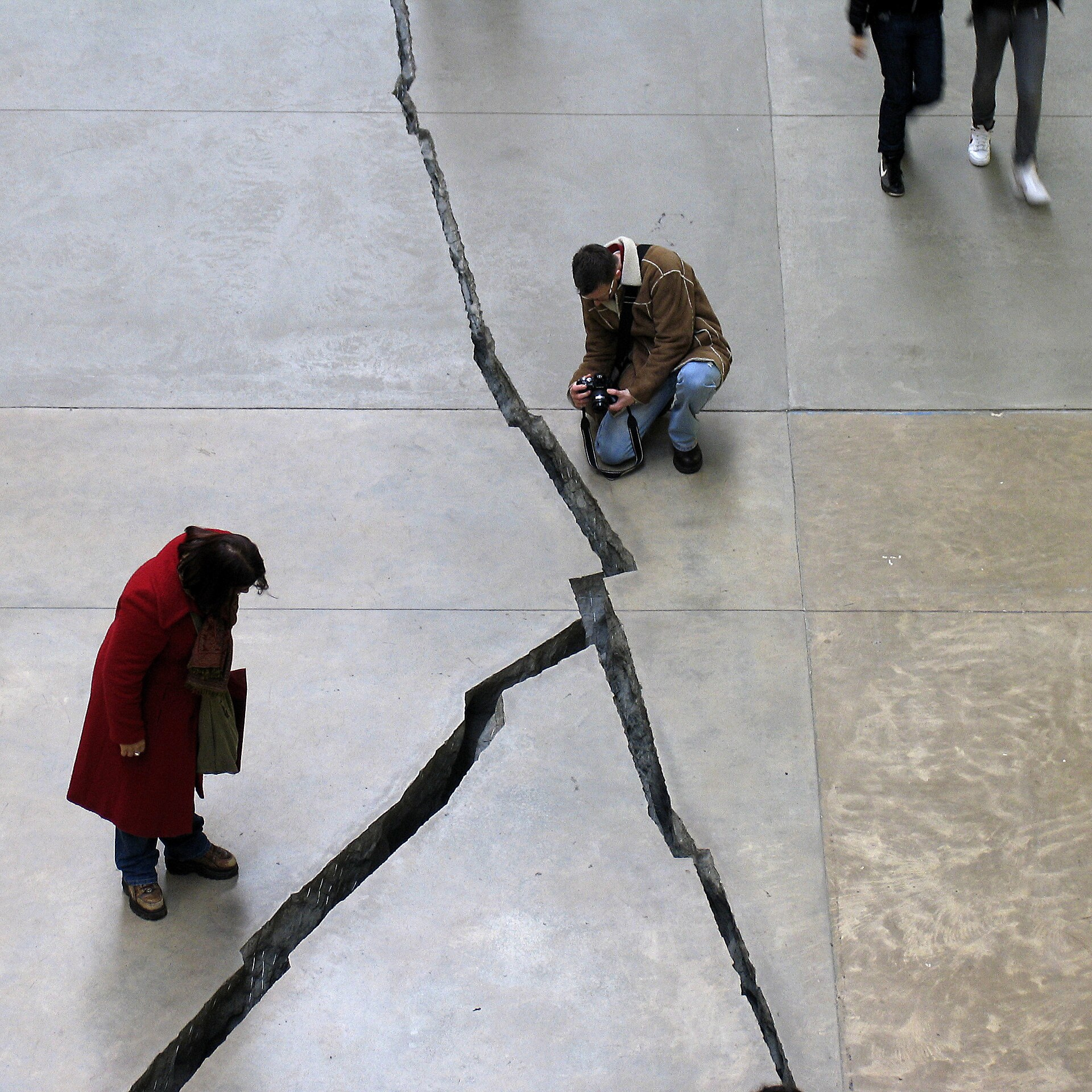
92. Shibboleth (2007) — Doris Salcedo. A crack, 167 meters long, opening across the Tate Modern’s Turbine Hall floor. The Colombian artist titled it for the biblical test-word used to sort insider from outsider at a border; the fissure is her figure for racism and the immigrant’s exclusion — a wound in the floor of the institution itself, which healed over when the show closed, as institutions prefer.
93. The invisible enemy should not exist (2007– ) — Michael Rakowitz. In April 2003, as Baghdad fell, the National Museum of Iraq was looted of some fifteen thousand objects while American forces stood by. Rakowitz, an Iraqi-American artist whose mother’s family fled Iraq in the 1940s, has spent the years since remaking the missing artifacts — “reappearances,” he insists, not reconstructions — out of the Arabic newspapers and Middle Eastern food packaging of the diaspora in America. Even the title is a recovered object: it translates Aj-ibur-shapu, the processional street of ancient Babylon. The project reached Trafalgar Square in 2018 as a Lamassu for the Fourth Plinth, standing in for the guardian Islamic State had destroyed at Nineveh. What an empire lets vanish, the exiles rebuild from what they have.
94. Tatlin’s Whisper #5 (2008) — Tania Bruguera. Two mounted police officers, on loan from the actual Metropolitan Police, practiced crowd-control techniques on unsuspecting Tate Modern visitors — herding, splitting, cornering them in the museum. Nothing was explained. The Cuban artist’s point lands in the body before it reaches the mind: this is how power handles a crowd, and the crowd, even in a museum, mostly obeys.
95. HOPE (2008) — Shepard Fairey. A stenciled portrait of Barack Obama, built from a news photograph and distributed virally — posters, stickers, free downloads — until it became the visual shorthand of a presidential campaign and then of an era’s optimism. Its long afterlife, including the legal fight over its source image, is a case study in who owns a political icon once the public takes it.
96. Remembering (2009) — Ai Weiwei. Nine thousand children’s backpacks mounted on the facade of Munich’s Haus der Kunst, spelling out, in Chinese characters, a bereaved mother’s wish that her daughter be remembered as having lived happily for seven years. The work answers the Sichuan earthquake, the collapsed schools, and the state’s refusal to publish the dead children’s names — the artist’s own citizen investigation had compiled them.
97. ¿De qué otra cosa podríamos hablar? (What Else Could We Talk About?) (2009) — Teresa Margolles. Mexico’s pavilion at the Venice Biennale: fabrics soaked in blood and fluid from the scenes of narco-executions, jewelry made from windshield glass of shootings, and relatives of the murdered mopping the palace floor with water mixed with blood. Margolles, trained in forensic medicine, imports the drug war’s material evidence into art’s cleanest room and asks the title’s question. There is no good answer, which is the work.
The 2010s & 2020s
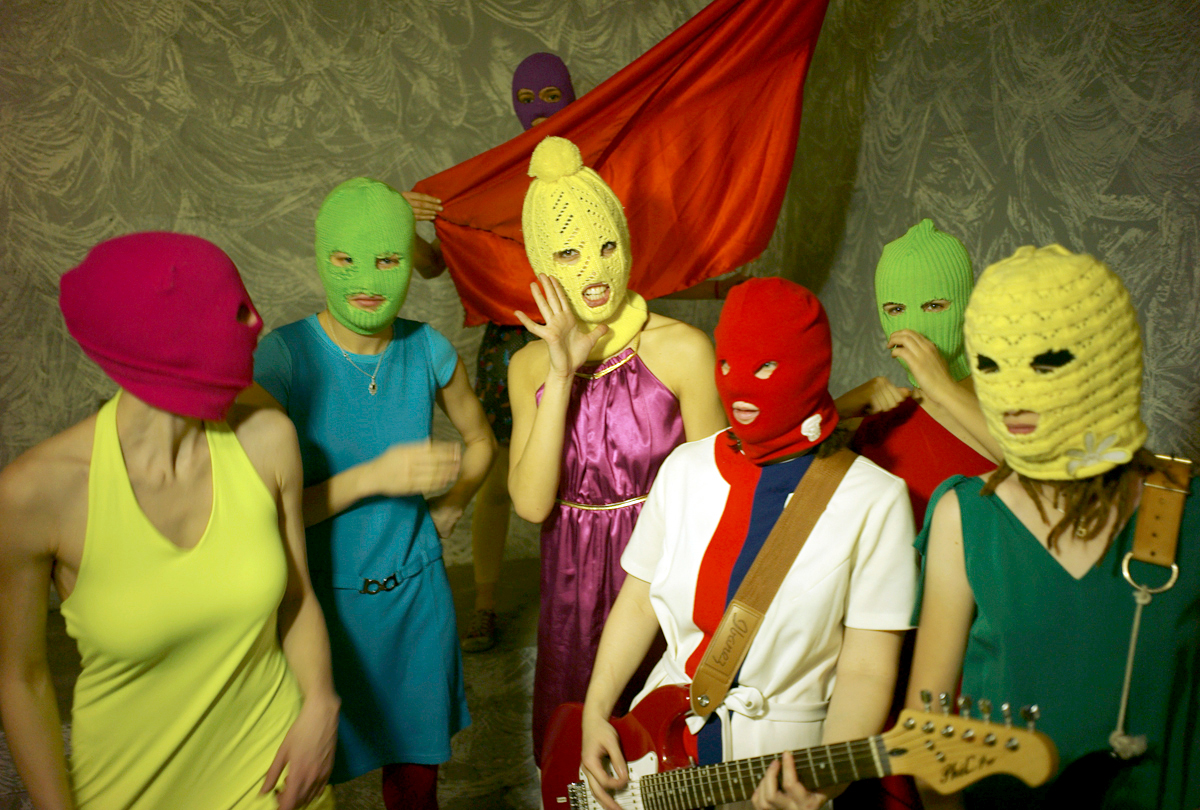
98. Punk Prayer (2012) — Pussy Riot. Forty seconds of balaclavas, bright dresses, and a punk song in Moscow’s Cathedral of Christ the Savior, protesting the Orthodox Church’s blessing of Vladimir Putin’s rule. Three members were tried and imprisoned. The performance’s brevity is the measure of its efficiency: a single unauthorized minute in the state’s holiest room echoed for a decade.
99. Somnyama Ngonyama (2012– ) — Zanele Muholi. An ongoing series of self-portraits — “Hail the Dark Lioness” — in which the South African artist confronts the camera costumed in materials that carry histories of labor, race, and displacement. Muholi calls themself a visual activist; the series is the argument’s archive, one portrait at a time, against the erasure of Black queer South Africans.
100. A Man Was Lynched by Police Yesterday (2015) — Dread Scott. A black flag, white block letters, one sentence — modeled on the banner the NAACP flew from its New York headquarters the day after each lynching in the 1920s and 30s, updated by two words. Scott made it after the police killing of Walter Scott in South Carolina. The flag’s power is grammatical: the past tense keeps being wrong.
101. The Photograph of Alan Kurdi (2015) — Nilüfer Demir. In the early morning of September 2, 2015, on a beach at Bodrum, Demir — a Turkish photojournalist covering the refugee crossings to Greece — found the body of a drowned Syrian toddler at the waterline, and did her job: she photographed him. Within hours the picture had circled the planet under the hashtag “humanity washed ashore.” Donations to refugee charities surged; governments that had been shutting doors began, briefly, to open them. Alan Kurdi was two years old, a Kurdish child from Kobani. The photograph’s afterlife is the argument about images themselves — whether witness changes policy or only decorates its delay — and no work on this list asks the question harder.
102. Flint Is Family (2016) — LaToya Ruby Frazier. Five months in Flint, Michigan, photographing three generations of one family — poet and bus driver Shea Cobb, her daughter, and her mother — living through a water crisis their government caused and then denied. Frazier’s collaborative portraits refuse the disaster-photo script: their subjects are not evidence, they are co-authors.
103. The Scream (2017) — Kent Monkman. Painted for Canada’s 150th birthday, against it: Mounties hold back wailing mothers while priests tear Indigenous children from their arms — the residential school system, which seized more than 150,000 children, rendered at the scale and in the manner of a Rubens massacre. Monkman, a Cree artist whose grandmother survived the schools, borrowed Munch’s title and Baroque history painting’s grandeur to file the charge the national celebration was omitting. When unmarked graves were confirmed at the Kamloops school in 2021, the painting went around the world again — an old image arriving, like the reckoning, a century late and exactly on time.
104. 77sqm_9:26min (2017) — Forensic Architecture. A full-scale reconstruction — digital model and physical set — of a Kassel internet café where a far-right terrorist murdered Halit Yozgat in 2006, built to test a German intelligence officer’s claim that he was present and noticed nothing. Shown at documenta 14, the counter-investigation demonstrated, sensor by sensor, that the testimony could not hold. Art, here, is not metaphor; it is cross-examination.
105. Rumors of War (2019) — Kehinde Wiley. A twenty-seven-foot bronze: a young Black man in a hoodie and sneakers, astride a rearing horse, posed after Richmond’s Confederate monument to General J.E.B. Stuart. Unveiled first in Times Square, then installed permanently at the Virginia Museum of Fine Arts, minutes from Monument Avenue — where, the following year, the Confederates came down. Wiley’s answer to a false history was not removal but a better monument.
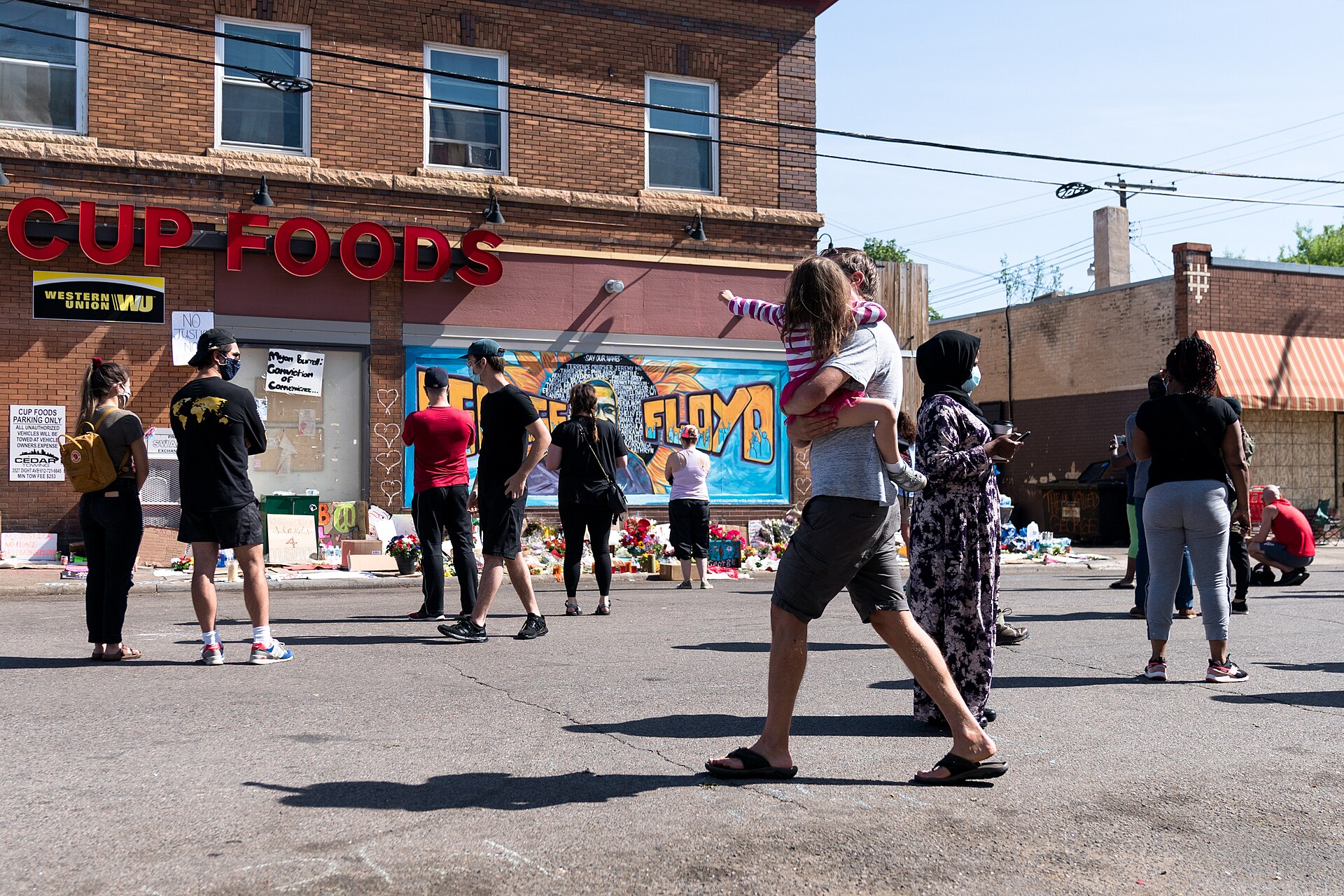
106. George Floyd Mural (2020) — Xena Goldman, Cadex Herrera, Greta McLain, and collaborators. Painted in days on the wall of the Minneapolis store where George Floyd was murdered, his face at the center of a sunflower ringed with the names of other Black Americans killed by police. The mural turned a crime scene into a gathering place and an image the whole world learned by heart — street painting doing the oldest job on this list.
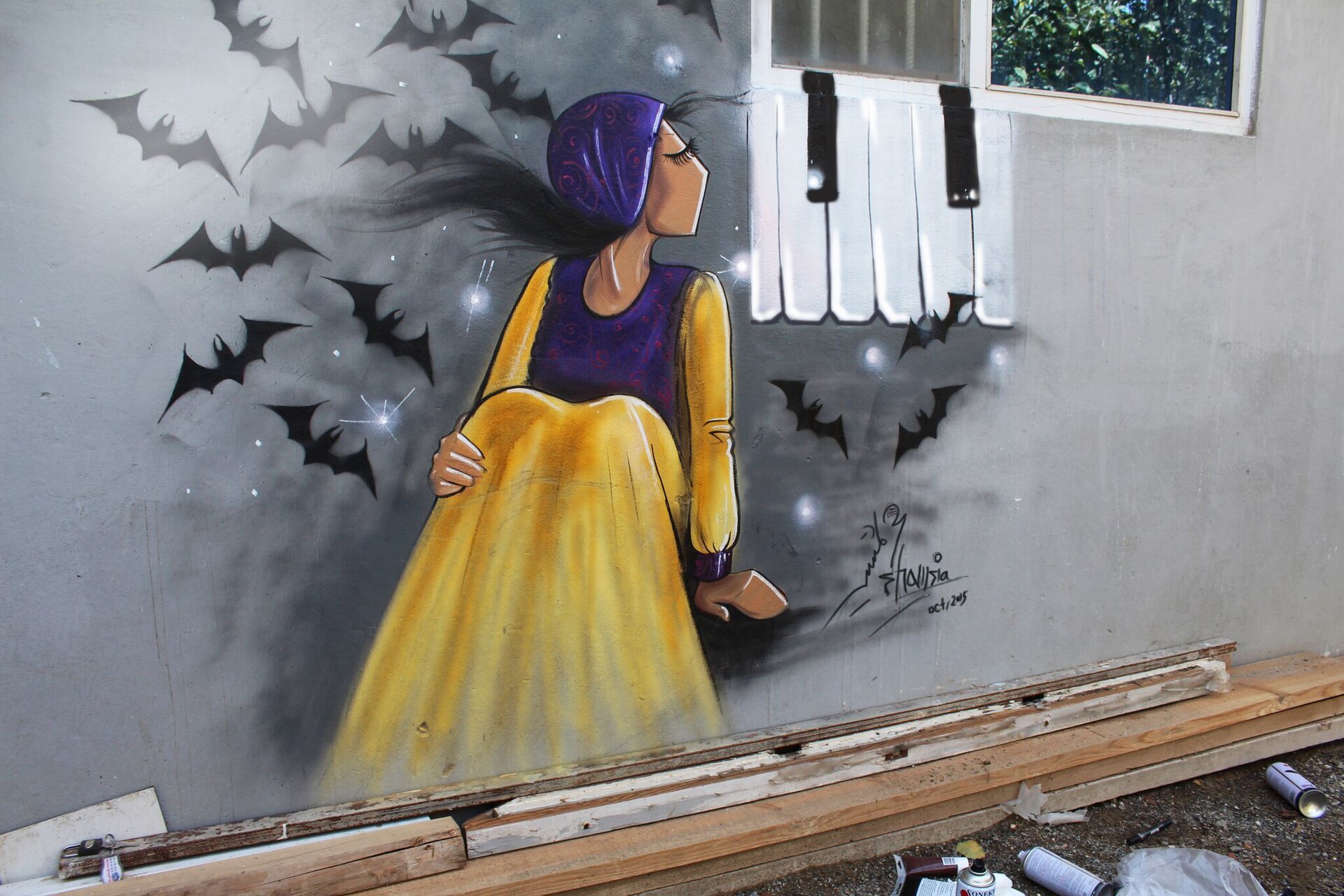
107. Nightmare (2021) — Shamsia Hassani. Released days before Kabul fell: a burqa-clad woman clutching a musical instrument, ringed by the dark shapes of armed men. Hassani — Afghanistan’s first woman graffiti artist — painted her recurring figure for a decade on Kabul’s walls; the Taliban’s return erased her murals within weeks. The images survive everywhere except where they were made, which is the story of Afghan art now.
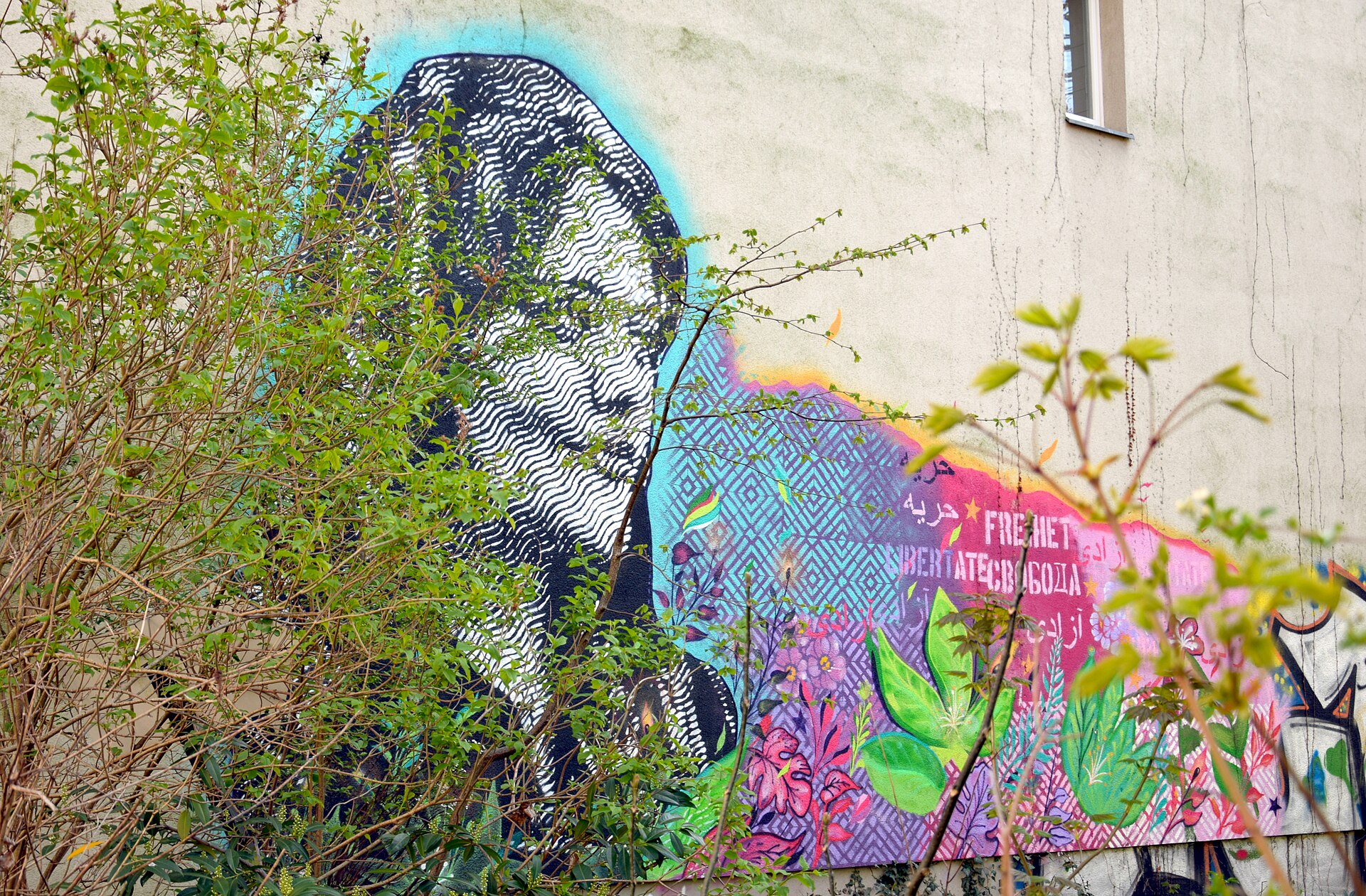
108. Woman, Life, Freedom graphics (2022) — artists of Iran and the diaspora. After Mahsa (Zhina) Amini died in morality-police custody, the Kurdish slogan of her movement became the decade’s most reproduced artwork — thousands of posters, digital images, and stencils by named and anonymous artists, including twelve red banners unfurled down the Guggenheim’s rotunda by the Anonymous Artist Collective for Iran. A graphic language built in real time, under blackout conditions, that the whole world can now read.
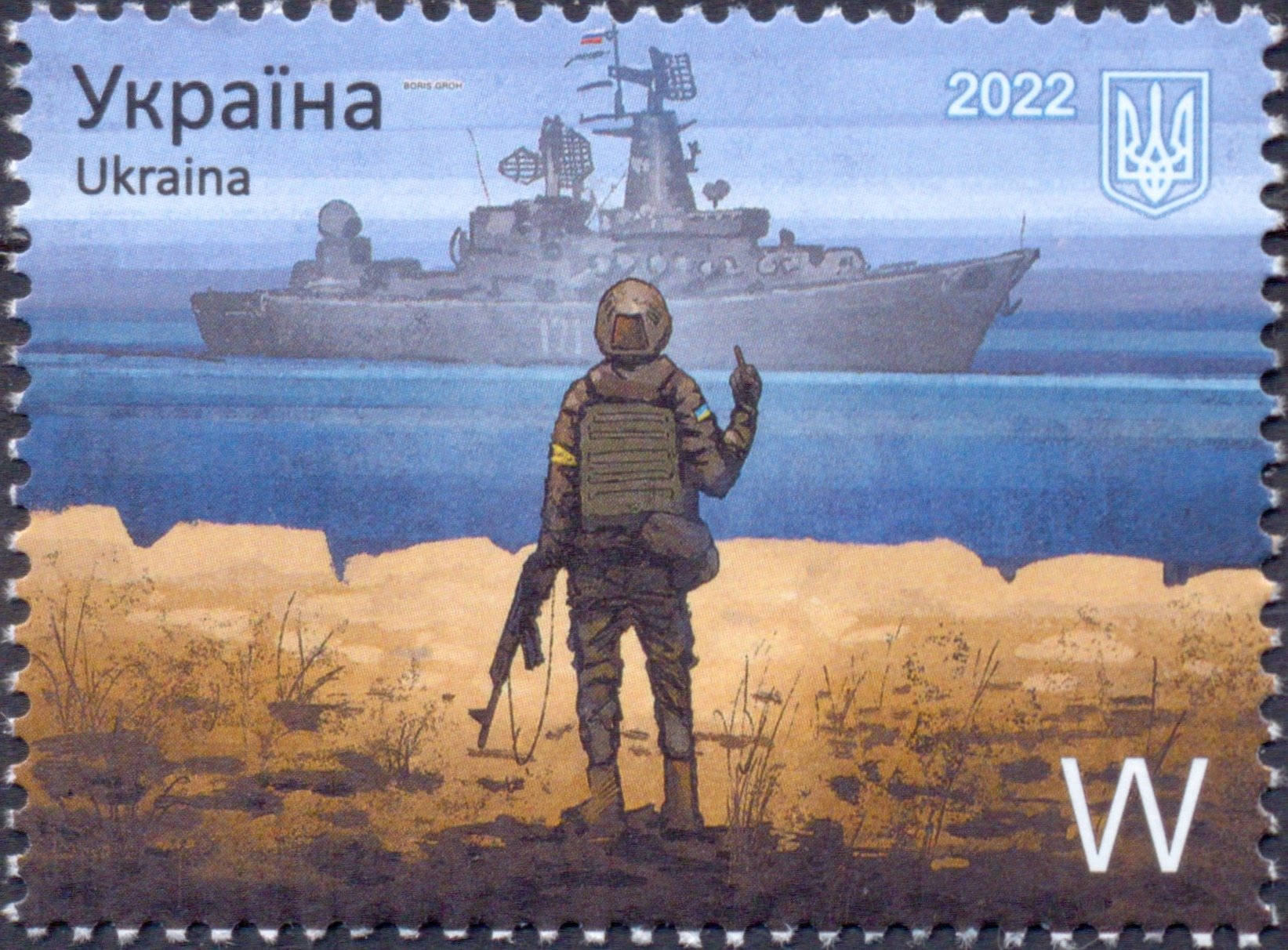
109. “Russian warship, go fuck yourself” postage stamp (2022) — Boris Groh. On the invasion’s first day, the Ukrainian garrison on Snake Island answered the cruiser Moskva’s surrender demand with an obscenity heard around the world, and Ukraine’s postal service did what no war ministry had thought of: it held a public contest to put the moment on a stamp. Groh’s winning design — a lone soldier on the shore, middle finger raised at the warship — was issued on April 12, 2022; the first printing of half a million sold out within days, and queues formed outside Kyiv’s main post office. Two days later, the Moskva sank. A postage stamp is state art at its smallest and most literal: sovereignty, printed, gummed, and mailed to the world.
110. No Words (2024) — Malak Mattar. A monumental monochrome canvas — seven feet high, sixteen wide — painted in a month in London by a young artist from Gaza: a screaming horse, a boy, a cart bearing belongings and a shrouded body, and around them the documented fragments of a destroyed world. Mattar, who painted her way through war after war since childhood, abandoned her signature color for this. The title reports the condition; the painting answers it.
What a Century of Witness Teaches
Read straight through, the hundred and ten works above make three arguments at once. Art is a document: Miller’s negatives, Cole’s smuggled film, and Abedin’s ink sketches have outlasted every official account that contradicted them. Art is a weapon: Klutsis, Toidze, Medu, and ACT UP’s poster artists all built images to be used, not admired, and some were answered with raids, prisons, and exile. And art is a witness that refuses the frame it is given — which is why the list’s center of gravity keeps moving: from Berlin and Moscow to Mexico City, Cairo, Johannesburg, Tehran, Kabul, Khartoum, Gaza. The next century’s list is already being made, disproportionately by people drawing, stitching, and posting from inside the events the rest of us watch on screens.
The Grvy’s new Art desk opens with that conviction. This December we will be in Miami for Art Basel and Miami Art Week — on the floor, in the satellite fairs, and in the streets where this city’s own political art actually lives — filing the coverage this list is a down payment on. The century of witness is not finished. Neither are we.


Leave a Reply